

Number Of Protons In Cesium
 | |||||||||||||||||||||||||||||||||||||||||||||||||||||||||||||||||||||||||||||||||||||||||||||||||||||||||||||||||||||||||||||||||||||||||||||||||||||||||||||||||||||||||||||||||||||||||||||||||||||||||||||||||||||||||||||||||||||
| Caesium | |||||||||||||||||||||||||||||||||||||||||||||||||||||||||||||||||||||||||||||||||||||||||||||||||||||||||||||||||||||||||||||||||||||||||||||||||||||||||||||||||||||||||||||||||||||||||||||||||||||||||||||||||||||||||||||||||||||
|---|---|---|---|---|---|---|---|---|---|---|---|---|---|---|---|---|---|---|---|---|---|---|---|---|---|---|---|---|---|---|---|---|---|---|---|---|---|---|---|---|---|---|---|---|---|---|---|---|---|---|---|---|---|---|---|---|---|---|---|---|---|---|---|---|---|---|---|---|---|---|---|---|---|---|---|---|---|---|---|---|---|---|---|---|---|---|---|---|---|---|---|---|---|---|---|---|---|---|---|---|---|---|---|---|---|---|---|---|---|---|---|---|---|---|---|---|---|---|---|---|---|---|---|---|---|---|---|---|---|---|---|---|---|---|---|---|---|---|---|---|---|---|---|---|---|---|---|---|---|---|---|---|---|---|---|---|---|---|---|---|---|---|---|---|---|---|---|---|---|---|---|---|---|---|---|---|---|---|---|---|---|---|---|---|---|---|---|---|---|---|---|---|---|---|---|---|---|---|---|---|---|---|---|---|---|---|---|---|---|---|---|---|---|---|---|---|---|---|---|---|---|---|---|---|---|---|---|---|---|
| Pronunciation | | ||||||||||||||||||||||||||||||||||||||||||||||||||||||||||||||||||||||||||||||||||||||||||||||||||||||||||||||||||||||||||||||||||||||||||||||||||||||||||||||||||||||||||||||||||||||||||||||||||||||||||||||||||||||||||||||||||||
| Alternative proper noun | cesium (US) | ||||||||||||||||||||||||||||||||||||||||||||||||||||||||||||||||||||||||||||||||||||||||||||||||||||||||||||||||||||||||||||||||||||||||||||||||||||||||||||||||||||||||||||||||||||||||||||||||||||||||||||||||||||||||||||||||||||
| Appearance | pale gold | ||||||||||||||||||||||||||||||||||||||||||||||||||||||||||||||||||||||||||||||||||||||||||||||||||||||||||||||||||||||||||||||||||||||||||||||||||||||||||||||||||||||||||||||||||||||||||||||||||||||||||||||||||||||||||||||||||||
| Standard atomic weight A r°(Cs) |
| ||||||||||||||||||||||||||||||||||||||||||||||||||||||||||||||||||||||||||||||||||||||||||||||||||||||||||||||||||||||||||||||||||||||||||||||||||||||||||||||||||||||||||||||||||||||||||||||||||||||||||||||||||||||||||||||||||||
| Caesium in the periodic tabular array | |||||||||||||||||||||||||||||||||||||||||||||||||||||||||||||||||||||||||||||||||||||||||||||||||||||||||||||||||||||||||||||||||||||||||||||||||||||||||||||||||||||||||||||||||||||||||||||||||||||||||||||||||||||||||||||||||||||
| |||||||||||||||||||||||||||||||||||||||||||||||||||||||||||||||||||||||||||||||||||||||||||||||||||||||||||||||||||||||||||||||||||||||||||||||||||||||||||||||||||||||||||||||||||||||||||||||||||||||||||||||||||||||||||||||||||||
| Atomic number (Z) | 55 | ||||||||||||||||||||||||||||||||||||||||||||||||||||||||||||||||||||||||||||||||||||||||||||||||||||||||||||||||||||||||||||||||||||||||||||||||||||||||||||||||||||||||||||||||||||||||||||||||||||||||||||||||||||||||||||||||||||
| Group | group ane: hydrogen and alkali metals | ||||||||||||||||||||||||||||||||||||||||||||||||||||||||||||||||||||||||||||||||||||||||||||||||||||||||||||||||||||||||||||||||||||||||||||||||||||||||||||||||||||||||||||||||||||||||||||||||||||||||||||||||||||||||||||||||||||
| Menses | period half-dozen | ||||||||||||||||||||||||||||||||||||||||||||||||||||||||||||||||||||||||||||||||||||||||||||||||||||||||||||||||||||||||||||||||||||||||||||||||||||||||||||||||||||||||||||||||||||||||||||||||||||||||||||||||||||||||||||||||||||
| Block | s-block | ||||||||||||||||||||||||||||||||||||||||||||||||||||||||||||||||||||||||||||||||||||||||||||||||||||||||||||||||||||||||||||||||||||||||||||||||||||||||||||||||||||||||||||||||||||||||||||||||||||||||||||||||||||||||||||||||||||
| Electron configuration | [Xe] 6si | ||||||||||||||||||||||||||||||||||||||||||||||||||||||||||||||||||||||||||||||||||||||||||||||||||||||||||||||||||||||||||||||||||||||||||||||||||||||||||||||||||||||||||||||||||||||||||||||||||||||||||||||||||||||||||||||||||||
| Electrons per shell | two, 8, 18, eighteen, eight, one | ||||||||||||||||||||||||||||||||||||||||||||||||||||||||||||||||||||||||||||||||||||||||||||||||||||||||||||||||||||||||||||||||||||||||||||||||||||||||||||||||||||||||||||||||||||||||||||||||||||||||||||||||||||||||||||||||||||
| Physical properties | |||||||||||||||||||||||||||||||||||||||||||||||||||||||||||||||||||||||||||||||||||||||||||||||||||||||||||||||||||||||||||||||||||||||||||||||||||||||||||||||||||||||||||||||||||||||||||||||||||||||||||||||||||||||||||||||||||||
| Phase atSTP | solid | ||||||||||||||||||||||||||||||||||||||||||||||||||||||||||||||||||||||||||||||||||||||||||||||||||||||||||||||||||||||||||||||||||||||||||||||||||||||||||||||||||||||||||||||||||||||||||||||||||||||||||||||||||||||||||||||||||||
| Melting point | 301.7 One thousand (28.5 °C, 83.iii °F) | ||||||||||||||||||||||||||||||||||||||||||||||||||||||||||||||||||||||||||||||||||||||||||||||||||||||||||||||||||||||||||||||||||||||||||||||||||||||||||||||||||||||||||||||||||||||||||||||||||||||||||||||||||||||||||||||||||||
| Boiling point | 944 Yard (671 °C, 1240 °F) | ||||||||||||||||||||||||||||||||||||||||||||||||||||||||||||||||||||||||||||||||||||||||||||||||||||||||||||||||||||||||||||||||||||||||||||||||||||||||||||||||||||||||||||||||||||||||||||||||||||||||||||||||||||||||||||||||||||
| Density (nearr.t.) | one.93 g/cmiii | ||||||||||||||||||||||||||||||||||||||||||||||||||||||||||||||||||||||||||||||||||||||||||||||||||||||||||||||||||||||||||||||||||||||||||||||||||||||||||||||||||||||||||||||||||||||||||||||||||||||||||||||||||||||||||||||||||||
| when liquid (atm.p.) | ane.843 thou/cm3 | ||||||||||||||||||||||||||||||||||||||||||||||||||||||||||||||||||||||||||||||||||||||||||||||||||||||||||||||||||||||||||||||||||||||||||||||||||||||||||||||||||||||||||||||||||||||||||||||||||||||||||||||||||||||||||||||||||||
| Disquisitional signal | 1938 Thou, 9.4 MPa[two] | ||||||||||||||||||||||||||||||||||||||||||||||||||||||||||||||||||||||||||||||||||||||||||||||||||||||||||||||||||||||||||||||||||||||||||||||||||||||||||||||||||||||||||||||||||||||||||||||||||||||||||||||||||||||||||||||||||||
| Heat of fusion | two.09 kJ/mol | ||||||||||||||||||||||||||||||||||||||||||||||||||||||||||||||||||||||||||||||||||||||||||||||||||||||||||||||||||||||||||||||||||||||||||||||||||||||||||||||||||||||||||||||||||||||||||||||||||||||||||||||||||||||||||||||||||||
| Rut of vaporization | 63.9 kJ/mol | ||||||||||||||||||||||||||||||||||||||||||||||||||||||||||||||||||||||||||||||||||||||||||||||||||||||||||||||||||||||||||||||||||||||||||||||||||||||||||||||||||||||||||||||||||||||||||||||||||||||||||||||||||||||||||||||||||||
| Molar heat capacity | 32.210 J/(mol·K) | ||||||||||||||||||||||||||||||||||||||||||||||||||||||||||||||||||||||||||||||||||||||||||||||||||||||||||||||||||||||||||||||||||||||||||||||||||||||||||||||||||||||||||||||||||||||||||||||||||||||||||||||||||||||||||||||||||||
Vapour pressure
| |||||||||||||||||||||||||||||||||||||||||||||||||||||||||||||||||||||||||||||||||||||||||||||||||||||||||||||||||||||||||||||||||||||||||||||||||||||||||||||||||||||||||||||||||||||||||||||||||||||||||||||||||||||||||||||||||||||
| Diminutive properties | |||||||||||||||||||||||||||||||||||||||||||||||||||||||||||||||||||||||||||||||||||||||||||||||||||||||||||||||||||||||||||||||||||||||||||||||||||||||||||||||||||||||||||||||||||||||||||||||||||||||||||||||||||||||||||||||||||||
| Oxidation states | −ane, +1 [3] (a strongly basic oxide) | ||||||||||||||||||||||||||||||||||||||||||||||||||||||||||||||||||||||||||||||||||||||||||||||||||||||||||||||||||||||||||||||||||||||||||||||||||||||||||||||||||||||||||||||||||||||||||||||||||||||||||||||||||||||||||||||||||||
| Electronegativity | Pauling scale: 0.79 | ||||||||||||||||||||||||||||||||||||||||||||||||||||||||||||||||||||||||||||||||||||||||||||||||||||||||||||||||||||||||||||||||||||||||||||||||||||||||||||||||||||||||||||||||||||||||||||||||||||||||||||||||||||||||||||||||||||
| Ionization energies |
| ||||||||||||||||||||||||||||||||||||||||||||||||||||||||||||||||||||||||||||||||||||||||||||||||||||||||||||||||||||||||||||||||||||||||||||||||||||||||||||||||||||||||||||||||||||||||||||||||||||||||||||||||||||||||||||||||||||
| Diminutive radius | empirical: 265 pm | ||||||||||||||||||||||||||||||||||||||||||||||||||||||||||||||||||||||||||||||||||||||||||||||||||||||||||||||||||||||||||||||||||||||||||||||||||||||||||||||||||||||||||||||||||||||||||||||||||||||||||||||||||||||||||||||||||||
| Covalent radius | 244±11 pm | ||||||||||||||||||||||||||||||||||||||||||||||||||||||||||||||||||||||||||||||||||||||||||||||||||||||||||||||||||||||||||||||||||||||||||||||||||||||||||||||||||||||||||||||||||||||||||||||||||||||||||||||||||||||||||||||||||||
| Van der Waals radius | 343 pm | ||||||||||||||||||||||||||||||||||||||||||||||||||||||||||||||||||||||||||||||||||||||||||||||||||||||||||||||||||||||||||||||||||||||||||||||||||||||||||||||||||||||||||||||||||||||||||||||||||||||||||||||||||||||||||||||||||||
| | |||||||||||||||||||||||||||||||||||||||||||||||||||||||||||||||||||||||||||||||||||||||||||||||||||||||||||||||||||||||||||||||||||||||||||||||||||||||||||||||||||||||||||||||||||||||||||||||||||||||||||||||||||||||||||||||||||||
| Other properties | |||||||||||||||||||||||||||||||||||||||||||||||||||||||||||||||||||||||||||||||||||||||||||||||||||||||||||||||||||||||||||||||||||||||||||||||||||||||||||||||||||||||||||||||||||||||||||||||||||||||||||||||||||||||||||||||||||||
| Natural occurrence | primordial | ||||||||||||||||||||||||||||||||||||||||||||||||||||||||||||||||||||||||||||||||||||||||||||||||||||||||||||||||||||||||||||||||||||||||||||||||||||||||||||||||||||||||||||||||||||||||||||||||||||||||||||||||||||||||||||||||||||
| Crystal structure | trunk-centred cubic (bcc) | ||||||||||||||||||||||||||||||||||||||||||||||||||||||||||||||||||||||||||||||||||||||||||||||||||||||||||||||||||||||||||||||||||||||||||||||||||||||||||||||||||||||||||||||||||||||||||||||||||||||||||||||||||||||||||||||||||||
| Thermal expansion | 97 µm/(m⋅M) (at 25 °C) | ||||||||||||||||||||||||||||||||||||||||||||||||||||||||||||||||||||||||||||||||||||||||||||||||||||||||||||||||||||||||||||||||||||||||||||||||||||||||||||||||||||||||||||||||||||||||||||||||||||||||||||||||||||||||||||||||||||
| Thermal conductivity | 35.9 West/(m⋅Chiliad) | ||||||||||||||||||||||||||||||||||||||||||||||||||||||||||||||||||||||||||||||||||||||||||||||||||||||||||||||||||||||||||||||||||||||||||||||||||||||||||||||||||||||||||||||||||||||||||||||||||||||||||||||||||||||||||||||||||||
| Electric resistivity | 205 nΩ⋅m (at 20 °C) | ||||||||||||||||||||||||||||||||||||||||||||||||||||||||||||||||||||||||||||||||||||||||||||||||||||||||||||||||||||||||||||||||||||||||||||||||||||||||||||||||||||||||||||||||||||||||||||||||||||||||||||||||||||||||||||||||||||
| Magnetic ordering | paramagnetic[iv] | ||||||||||||||||||||||||||||||||||||||||||||||||||||||||||||||||||||||||||||||||||||||||||||||||||||||||||||||||||||||||||||||||||||||||||||||||||||||||||||||||||||||||||||||||||||||||||||||||||||||||||||||||||||||||||||||||||||
| Immature'south modulus | 1.7 GPa | ||||||||||||||||||||||||||||||||||||||||||||||||||||||||||||||||||||||||||||||||||||||||||||||||||||||||||||||||||||||||||||||||||||||||||||||||||||||||||||||||||||||||||||||||||||||||||||||||||||||||||||||||||||||||||||||||||||
| Bulk modulus | 1.6 GPa | ||||||||||||||||||||||||||||||||||||||||||||||||||||||||||||||||||||||||||||||||||||||||||||||||||||||||||||||||||||||||||||||||||||||||||||||||||||||||||||||||||||||||||||||||||||||||||||||||||||||||||||||||||||||||||||||||||||
| Mohs hardness | 0.2 | ||||||||||||||||||||||||||||||||||||||||||||||||||||||||||||||||||||||||||||||||||||||||||||||||||||||||||||||||||||||||||||||||||||||||||||||||||||||||||||||||||||||||||||||||||||||||||||||||||||||||||||||||||||||||||||||||||||
| Brinell hardness | 0.14 MPa | ||||||||||||||||||||||||||||||||||||||||||||||||||||||||||||||||||||||||||||||||||||||||||||||||||||||||||||||||||||||||||||||||||||||||||||||||||||||||||||||||||||||||||||||||||||||||||||||||||||||||||||||||||||||||||||||||||||
| CAS Number | 7440-46-2 | ||||||||||||||||||||||||||||||||||||||||||||||||||||||||||||||||||||||||||||||||||||||||||||||||||||||||||||||||||||||||||||||||||||||||||||||||||||||||||||||||||||||||||||||||||||||||||||||||||||||||||||||||||||||||||||||||||||
| History | |||||||||||||||||||||||||||||||||||||||||||||||||||||||||||||||||||||||||||||||||||||||||||||||||||||||||||||||||||||||||||||||||||||||||||||||||||||||||||||||||||||||||||||||||||||||||||||||||||||||||||||||||||||||||||||||||||||
| Naming | from Latin caesius , heaven blueish, for its spectral colours | ||||||||||||||||||||||||||||||||||||||||||||||||||||||||||||||||||||||||||||||||||||||||||||||||||||||||||||||||||||||||||||||||||||||||||||||||||||||||||||||||||||||||||||||||||||||||||||||||||||||||||||||||||||||||||||||||||||
| Discovery | Robert Bunsen and Gustav Kirchhoff (1860) | ||||||||||||||||||||||||||||||||||||||||||||||||||||||||||||||||||||||||||||||||||||||||||||||||||||||||||||||||||||||||||||||||||||||||||||||||||||||||||||||||||||||||||||||||||||||||||||||||||||||||||||||||||||||||||||||||||||
| First isolation | Carl Setterberg (1882) | ||||||||||||||||||||||||||||||||||||||||||||||||||||||||||||||||||||||||||||||||||||||||||||||||||||||||||||||||||||||||||||||||||||||||||||||||||||||||||||||||||||||||||||||||||||||||||||||||||||||||||||||||||||||||||||||||||||
| Chief isotopes of caesium | |||||||||||||||||||||||||||||||||||||||||||||||||||||||||||||||||||||||||||||||||||||||||||||||||||||||||||||||||||||||||||||||||||||||||||||||||||||||||||||||||||||||||||||||||||||||||||||||||||||||||||||||||||||||||||||||||||||
| |||||||||||||||||||||||||||||||||||||||||||||||||||||||||||||||||||||||||||||||||||||||||||||||||||||||||||||||||||||||||||||||||||||||||||||||||||||||||||||||||||||||||||||||||||||||||||||||||||||||||||||||||||||||||||||||||||||


 Category: Caesium
Caesium (IUPAC spelling[half-dozen]) (or cesium in American English)[note i] is a element with the symbol Cs and atomic number 55. Information technology is a soft, silvery-gilded alkali metallic with a melting point of 28.5 °C (83.3 °F), which makes information technology one of only five elemental metals that are liquid at or near room temperature.[note 2] Caesium has concrete and chemical backdrop like to those of rubidium and potassium. Information technology is pyrophoric and reacts with water even at −116 °C (−177 °F). It is the least electronegative element, with a value of 0.79 on the Pauling scale. It has just i stable isotope, caesium-133. Caesium is mined mostly from pollucite. The element has xl known isotopes, making it, along with barium and mercury, 1 of the elements with the near isotopes.[11] Caesium-137, a fission production, is extracted from waste material produced by nuclear reactors.[ why? ]
The High german pharmacist Robert Bunsen and physicist Gustav Kirchhoff discovered caesium in 1860 by the newly adult method of flame spectroscopy. The kickoff small-scale applications for caesium were every bit a "getter" in vacuum tubes and in photoelectric cells. In 1967, acting on Einstein'south proof that the speed of light is the nearly constant dimension in the universe, the International System of Units used two specific wave counts from an emission spectrum of caesium-133 to co-define the second and the metre. Since then, caesium has been widely used in highly accurate diminutive clocks.
Since the 1990s, the largest awarding of the element has been as caesium formate for drilling fluids, only it has a range of applications in the production of electricity, in electronics, and in chemistry. The radioactive isotope caesium-137 has a half-life of nearly 30 years and is used in medical applications, industrial gauges, and hydrology. Nonradioactive caesium compounds are just mildly toxic, but the pure metal's trend to react explosively with water means that caesium is considered a hazardous cloth, and the radioisotopes present a significant health and ecological hazard in the surroundings.
Characteristics [edit]
Concrete properties [edit]

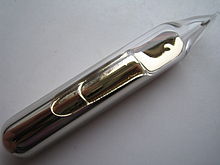
Loftier-purity caesium-133 stored in argon.
Of all elements that are solid at room temperature, caesium is the softest: it has a hardness of 0.2 Mohs. It is a very ductile, stake metal, which darkens in the presence of trace amounts of oxygen.[12] [13] [14] When in the presence of mineral oil (where it is best kept during transport), it loses its metallic lustre and takes on a duller, grey appearance. Information technology has a melting point of 28.5 °C (83.3 °F), making it one of the few elemental metals that are liquid near room temperature. Mercury is the only stable elemental metallic with a known melting point lower than caesium.[annotation 3] [16] In improver, the metal has a rather low boiling point, 641 °C (1,186 °F), the lowest of all metals other than mercury.[17] Its compounds fire with a blueish[xviii] [19] or violet[nineteen] colour.
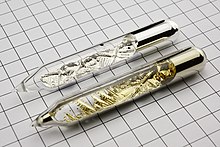
Caesium crystals (aureate) compared to rubidium crystals (silvery)
Caesium forms alloys with the other alkali metals, aureate, and mercury (amalgams). At temperatures below 650 °C (one,202 °F), it does not blend with cobalt, iron, molybdenum, nickel, platinum, tantalum, or tungsten. Information technology forms well-divers intermetallic compounds with antimony, gallium, indium, and thorium, which are photosensitive.[12] It mixes with all the other alkali metals (except lithium); the blend with a molar distribution of 41% caesium, 47% potassium, and 12% sodium has the lowest melting point of any known metal blend, at −78 °C (−108 °F).[xvi] [20] A few amalgams have been studied: CsHg
two is black with a royal metallic lustre, while CsHg is gilded-coloured, too with a metallic lustre.[21]
The gold color of caesium comes from the decreasing frequency of light required to excite electrons of the brine metals as the grouping is descended. For lithium through rubidium this frequency is in the ultraviolet, but for caesium it enters the blue–violet cease of the spectrum; in other words, the plasmonic frequency of the alkali metals becomes lower from lithium to caesium. Thus caesium transmits and partially absorbs violet light preferentially while other colours (having lower frequency) are reflected; hence it appears yellowish.[22]
Chemical properties [edit]
Add-on of a small amount of caesium to common cold water is explosive.
Caesium metal is highly reactive and very pyrophoric. Information technology ignites spontaneously in air, and reacts explosively with water even at low temperatures, more than then than the other brine metals (first group of the periodic table).[12] It reacts with water ice at temperatures as low as −116 °C (−177 °F).[sixteen] Because of this high reactivity, caesium metallic is classified as a hazardous material. It is stored and shipped in dry, saturated hydrocarbons such as mineral oil. It tin can exist handled only under inert gas, such equally argon. However, a caesium-water explosion is often less powerful than a sodium-water explosion with a similar amount of sodium. This is because caesium explodes instantly upon contact with h2o, leaving niggling time for hydrogen to accumulate.[23] Caesium tin can be stored in vacuum-sealed borosilicate glass ampoules. In quantities of more than about 100 grams (3.v oz), caesium is shipped in hermetically sealed, stainless steel containers.[12]
The chemistry of caesium is like to that of other alkali metals, in item rubidium, the element above caesium in the periodic table.[24] As expected for an alkali metallic, the only common oxidation land is +one.[note 4] Some slight differences arise from the fact that it has a college diminutive mass and is more electropositive than other (nonradioactive) alkali metals.[26] Caesium is the nigh electropositive element.[notation 5] [sixteen] The caesium ion is as well larger and less "hard" than those of the lighter brine metals.
Compounds [edit]
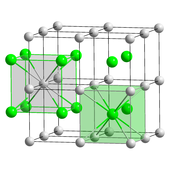
Ball-and-stick model of the cubic coordination of Cs and Cl in CsCl
Most caesium compounds contain the element equally the cation Cs +
, which binds ionically to a broad variety of anions. 1 noteworthy exception is the caeside anion (Cs −
),[3] and others are the several suboxides (see section on oxides below). More recently, caesium is predicted to bear as a p-block element and capable of forming higher fluorides with college oxidation states (i.e., CsFn with due north > i) nether high pressure level.[28] This prediction needs to be validated by further experiments.[29]
Salts of Cs+ are usually colourless unless the anion itself is coloured. Many of the uncomplicated salts are hygroscopic, but less so than the corresponding salts of lighter alkali metals. The phosphate,[xxx] acetate, carbonate, halides, oxide, nitrate, and sulfate salts are water-soluble. Double salts are frequently less soluble, and the depression solubility of caesium aluminium sulfate is exploited in refining Cs from ores. The double salt with antimony (such every bit CsSbCl
4 ), bismuth, cadmium, copper, fe, and lead are too poorly soluble.[12]
Caesium hydroxide (CsOH) is hygroscopic and strongly basic.[24] It rapidly etches the surface of semiconductors such as silicon.[31] CsOH has been previously regarded by chemists every bit the "strongest base of operations", reflecting the relatively weak attraction between the large Cs+ ion and OH−;[18] it is indeed the strongest Arrhenius base of operations; however, a number of compounds such equally northward-butyllithium, sodium amide, sodium hydride, caesium hydride, etc., which cannot be dissolved in h2o as reacting violently with it but rather merely used in some anhydrous polar aprotic solvents, are far more than bones on the basis of the Brønsted–Lowry acid–base theory.[24]
A stoichiometric mixture of caesium and gold will react to form yellow caesium auride (Cs+Au−) upon heating. The auride anion hither behaves as a pseudohalogen. The compound reacts violently with water, yielding caesium hydroxide, metallic gold, and hydrogen gas; in liquid ammonia it can exist reacted with a caesium-specific ion exchange resin to produce tetramethylammonium auride. The analogous platinum compound, ruddy caesium platinide (Cs2Pt), contains the platinide ion that behaves as a pseudochalcogen.[32]
Complexes [edit]
Similar all metal cations, Cs+ forms complexes with Lewis bases in solution. Because of its large size, Cs+ usually adopts coordination numbers greater than half-dozen, the number typical for the smaller alkali metallic cations. This difference is apparent in the 8-coordination of CsCl. This high coordination number and softness (tendency to grade covalent bonds) are properties exploited in separating Cs+ from other cations in the remediation of nuclear wastes, where 137Cs+ must be separated from big amounts of nonradioactive K+.[33]
Halides [edit]
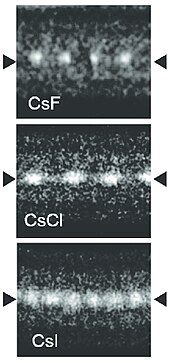
Caesium fluoride (CsF) is a hygroscopic white solid that is widely used in organofluorine chemistry as a source of fluoride anions.[35] Caesium fluoride has the halite structure, which means that the Cs+ and F− pack in a cubic closest packed assortment as practise Na+ and Cl− in sodium chloride.[24] Notably, caesium and fluorine have the lowest and highest electronegativities, respectively, amid all the known elements.
Caesium chloride (CsCl) crystallizes in the simple cubic crystal arrangement. Also chosen the "caesium chloride structure",[26] this structural motif is composed of a primitive cubic lattice with a two-atom basis, each with an eightfold coordination; the chloride atoms prevarication upon the lattice points at the edges of the cube, while the caesium atoms lie in the holes in the eye of the cubes. This structure is shared with CsBr and CsI, and many other compounds that do not contain Cs. In contrast, most other alkaline halides have the sodium chloride (NaCl) structure.[26] The CsCl structure is preferred considering Cs+ has an ionic radius of 174 pm and Cl −
181 pm.[36]
Oxides [edit]

More so than the other alkali metals, caesium forms numerous binary compounds with oxygen. When caesium burns in air, the superoxide CsO
two is the chief product.[37] The "normal" caesium oxide (Cs
2 O) forms yellow-orange hexagonal crystals,[38] and is the only oxide of the anti-CdCl
2 type.[39] It vaporizes at 250 °C (482 °F), and decomposes to caesium metallic and the peroxide Cs
2 O
2 at temperatures above 400 °C (752 °F). In add-on to the superoxide and the ozonide CsO
3 ,[40] [41] several brightly coloured suboxides take also been studied.[42] These include Cs
7 O, Cs
4 O, Cs
11 O
iii , Cs
3 O (dark-green[43]), CsO, Cs
3 O
2 ,[44] equally well every bit Cs
7 O
ii .[45] [46] The latter may be heated in a vacuum to generate Cs
2 O.[39] Binary compounds with sulfur, selenium, and tellurium also exist.[12]
Isotopes [edit]
Caesium has 40 known isotopes, ranging in mass number (i.e. number of nucleons in the nucleus) from 112 to 151. Several of these are synthesized from lighter elements by the slow neutron capture process (Southward-procedure) inside erstwhile stars[47] and by the R-process in supernova explosions.[48] The only stable caesium isotope is 133Cs, with 78 neutrons. Although it has a big nuclear spin ( 7 / 2 +), nuclear magnetic resonance studies can apply this isotope at a resonating frequency of xi.7 MHz.[49]

The radioactive 135Cs has a very long half-life of most 2.iii million years, the longest of all radioactive isotopes of caesium. 137Cs and 134Cs have half-lives of 30 and two years, respectively. 137Cs decomposes to a short-lived 137mBa by beta decay, and then to nonradioactive barium, while 134Cs transforms into 134Ba directly. The isotopes with mass numbers of 129, 131, 132 and 136, accept half-lives between a day and two weeks, while most of the other isotopes have half-lives from a few seconds to fractions of a second. At to the lowest degree 21 metastable nuclear isomers exist. Other than 134mCs (with a half-life of just nether iii hours), all are very unstable and decay with half-lives of a few minutes or less.[50] [51]
The isotope 135Cs is one of the long-lived fission products of uranium produced in nuclear reactors.[52] However, this fission production yield is reduced in most reactors because the predecessor, 135Xe, is a strong neutron toxicant and frequently transmutes to stable 136Xe before it can decay to 135Cs.[53] [54]
The beta decay from 137Cs to 137mBa is a strong emission of gamma radiation.[55] 137Cs and 90Sr are the principal medium-lived products of nuclear fission, and the prime number sources of radioactivity from spent nuclear fuel after several years of cooling, lasting several hundred years.[56] Those 2 isotopes are the largest source of remainder radioactivity in the area of the Chernobyl disaster.[57] Because of the depression capture rate, disposing of 137Cs through neutron capture is not viable and the only current solution is to permit it to decay over time.[58]
Most all caesium produced from nuclear fission comes from the beta disuse of originally more neutron-rich fission products, passing through various isotopes of iodine and xenon.[59] Considering iodine and xenon are volatile and tin can diffuse through nuclear fuel or air, radioactive caesium is often created far from the original site of fission.[60] With nuclear weapons testing in the 1950s through the 1980s, 137Cs was released into the atmosphere and returned to the surface of the world every bit a component of radioactive fallout. Information technology is a set up mark of the movement of soil and sediment from those times.[12]
Occurrence [edit]

Pollucite, a caesium mineral
Caesium is a relatively rare element, estimated to average three parts per million in the Earth'southward crust.[61] It is the 45th virtually abundant element and the 36th amongst the metals. Nevertheless, it is more arable than such elements every bit antimony, cadmium, tin, and tungsten, and ii orders of magnitude more arable than mercury and silver; it is iii.3% as abundant as rubidium, with which it is closely associated, chemically.[12]
Due to its big ionic radius, caesium is one of the "incompatible elements".[62] During magma crystallization, caesium is full-bodied in the liquid phase and crystallizes terminal. Therefore, the largest deposits of caesium are zone pegmatite ore bodies formed by this enrichment process. Because caesium does not substitute for potassium as readily equally rubidium does, the alkali evaporite minerals sylvite (KCl) and carnallite (KMgCl
3 ·6H
2 O) may comprise only 0.002% caesium. Consequently, caesium is found in few minerals. Percentage amounts of caesium may be found in beryl (Be
3 Al
2 (SiO
three )
6 ) and avogadrite ((G,Cs)BF
four ), up to 15 wt% Cs2O in the closely related mineral pezzottaite (Cs(Exist
2 Li)Al
ii Si
6 O
eighteen ), up to eight.4 wt% CsiiO in the rare mineral londonite ((Cs,Chiliad)Al
4 Exist
4 (B,Be)
12 O
28 ), and less in the more widespread rhodizite.[12] The but economically important ore for caesium is pollucite Cs(AlSi
two O
6 ), which is found in a few places around the world in zoned pegmatites, associated with the more commercially important lithium minerals, lepidolite and petalite. Within the pegmatites, the large grain size and the strong separation of the minerals results in high-grade ore for mining.[63]
The world'due south most significant and richest known source of caesium is the Tanco Mine at Bernic Lake in Manitoba, Canada, estimated to contain 350,000 metric tons of pollucite ore, representing more than 2-thirds of the world'south reserve base.[63] [64] Although the stoichiometric content of caesium in pollucite is 42.6%, pure pollucite samples from this deposit contain only well-nigh 34% caesium, while the average content is 24 wt%.[64] Commercial pollucite contains more than nineteen% caesium.[65] The Bikita pegmatite deposit in Zimbabwe is mined for its petalite, but information technology as well contains a significant amount of pollucite. Another notable source of pollucite is in the Karibib Desert, Namibia.[64] At the present charge per unit of earth mine production of 5 to 10 metric tons per twelvemonth, reserves will concluding for thousands of years.[12]
Production [edit]
Mining and refining pollucite ore is a selective process and is conducted on a smaller scale than for most other metals. The ore is crushed, hand-sorted, only not usually concentrated, and then ground. Caesium is and so extracted from pollucite primarily by 3 methods: acid digestion, element of group i decomposition, and direct reduction.[12] [66]
In the acid digestion, the silicate pollucite rock is dissolved with stiff acids, such as hydrochloric (HCl), sulfuric (H
2 And then
four ), hydrobromic (HBr), or hydrofluoric (HF) acids. With hydrochloric acid, a mixture of soluble chlorides is produced, and the insoluble chloride double salts of caesium are precipitated as caesium antimony chloride (Cs
4 SbCl
7 ), caesium iodine chloride (Cs
2 ICl), or caesium hexachlorocerate (Cs
2 (CeCl
six )). After separation, the pure precipitated double salt is decomposed, and pure CsCl is precipitated by evaporating the water.
The sulfuric acid method yields the insoluble double salt directly as caesium alum (CsAl(SO
iv )
ii ·12H
2 O). The aluminium sulfate component is converted to insoluble aluminium oxide by roasting the alum with carbon, and the resulting product is leached with water to yield a Cs
2 And then
4 solution.[12]
Roasting pollucite with calcium carbonate and calcium chloride yields insoluble calcium silicates and soluble caesium chloride. Leaching with h2o or dilute ammonia (NH
4 OH) yields a dilute chloride (CsCl) solution. This solution can be evaporated to produce caesium chloride or transformed into caesium alum or caesium carbonate. Though not commercially feasible, the ore can exist directly reduced with potassium, sodium, or calcium in vacuum to produce caesium metal directly.[12]
Most of the mined caesium (every bit salts) is direct converted into caesium formate (HCOO−Cs+) for applications such as oil drilling. To supply the developing market, Cabot Corporation built a production plant in 1997 at the Tanco mine about Bernic Lake in Manitoba, with a capacity of 12,000 barrels (1,900 chiliad3) per year of caesium formate solution.[67] The chief smaller-scale commercial compounds of caesium are caesium chloride and nitrate.[68]
Alternatively, caesium metal may be obtained from the purified compounds derived from the ore. Caesium chloride and the other caesium halides tin be reduced at 700 to 800 °C (1,292 to 1,472 °F) with calcium or barium, and caesium metal distilled from the result. In the aforementioned fashion, the aluminate, carbonate, or hydroxide may exist reduced past magnesium.[12]
The metal tin can also be isolated by electrolysis of fused caesium cyanide (CsCN). Exceptionally pure and gas-free caesium can exist produced by 390 °C (734 °F) thermal decomposition of caesium azide CsN
three , which can be produced from aqueous caesium sulfate and barium azide.[66] In vacuum applications, caesium dichromate can be reacted with zirconium to produce pure caesium metallic without other gaseous products.[68]
- Cs
2 Cr
2 O
7 + two Zr → 2 Cs + 2 ZrO
2 + Cr
2 O
3
The price of 99.viii% pure caesium (metal basis) in 2009 was nigh $10 per gram ($280/oz), simply the compounds are significantly cheaper.[64]
History [edit]
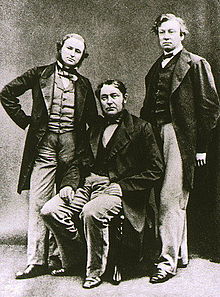
In 1860, Robert Bunsen and Gustav Kirchhoff discovered caesium in the mineral h2o from Dürkheim, Germany. Because of the bright blue lines in the emission spectrum, they derived the name from the Latin word caesius, meaning sky-bluish.[note 6] [69] [seventy] [71] Caesium was the beginning chemical element to be discovered with a spectroscope, which had been invented past Bunsen and Kirchhoff just a yr previously.[16]
To obtain a pure sample of caesium, 44,000 litres (9,700 imp gal; 12,000 U.s.a. gal) of mineral h2o had to exist evaporated to yield 240 kilograms (530 lb) of concentrated salt solution. The alkaline metal earth metals were precipitated either equally sulfates or oxalates, leaving the alkali metal in the solution. After conversion to the nitrates and extraction with ethanol, a sodium-costless mixture was obtained. From this mixture, the lithium was precipitated past ammonium carbonate. Potassium, rubidium, and caesium grade insoluble salts with chloroplatinic acid, but these salts evidence a slight deviation in solubility in hot h2o, and the less-soluble caesium and rubidium hexachloroplatinate ((Cs,Rb)2PtClhalf-dozen) were obtained by fractional crystallization. Afterward reduction of the hexachloroplatinate with hydrogen, caesium and rubidium were separated by the difference in solubility of their carbonates in alcohol. The process yielded ix.ii grams (0.32 oz) of rubidium chloride and 7.3 grams (0.26 oz) of caesium chloride from the initial 44,000 litres of mineral water.[seventy]
From the caesium chloride, the 2 scientists estimated the diminutive weight of the new element at 123.35 (compared to the currently accepted one of 132.9).[70] They tried to generate elemental caesium past electrolysis of molten caesium chloride, but instead of a metal, they obtained a blue homogeneous substance which "neither under the naked eye nor under the microscope showed the slightest trace of metal substance"; equally a result, they assigned information technology as a subchloride (Cs
2 Cl). In reality, the product was probably a colloidal mixture of the metallic and caesium chloride.[72] The electrolysis of the aqueous solution of chloride with a mercury cathode produced a caesium constructing which readily decomposed under the aqueous weather condition.[seventy] The pure metallic was somewhen isolated past the German chemist Carl Setterberg while working on his doctorate with Kekulé and Bunsen.[71] In 1882, he produced caesium metal by electrolysing caesium cyanide, avoiding the problems with the chloride.[73]
Historically, the about important employ for caesium has been in research and evolution, primarily in chemic and electric fields. Very few applications existed for caesium until the 1920s, when it came into utilize in radio vacuum tubes, where it had two functions; as a getter, it removed backlog oxygen later on manufacture, and equally a coating on the heated cathode, it increased the electrical conductivity. Caesium was not recognized equally a high-performance industrial metal until the 1950s.[74] Applications for nonradioactive caesium included photoelectric cells, photomultiplier tubes, optical components of infrared spectrophotometers, catalysts for several organic reactions, crystals for scintillation counters, and in magnetohydrodynamic power generators.[12] Caesium is also used equally a source of positive ions in secondary ion mass spectrometry (SIMS).
Since 1967, the International System of Measurements has based the primary unit of time, the 2d, on the backdrop of caesium. The International System of Units (SI) defines the second as the duration of ix,192,631,770 cycles at the microwave frequency of the spectral line corresponding to the transition between two hyperfine energy levels of the ground land of caesium-133.[75] The 13th General Conference on Weights and Measures of 1967 divers a second as: "the duration of nine,192,631,770 cycles of microwave light captivated or emitted by the hyperfine transition of caesium-133 atoms in their ground state undisturbed past external fields".
Applications [edit]
Petroleum exploration [edit]
The largest present-24-hour interval use of nonradioactive caesium is in caesium formate drilling fluids for the extractive oil industry.[12] Aqueous solutions of caesium formate (HCOO−Cs+)—made past reacting caesium hydroxide with formic acid—were developed in the mid-1990s for use every bit oil well drilling and completion fluids. The function of a drilling fluid is to lubricate drill bits, to bring stone cuttings to the surface, and to maintain pressure level on the formation during drilling of the well. Completion fluids assist the emplacement of command hardware after drilling just prior to production by maintaining the pressure.[12]
The high density of the caesium formate brine (up to 2.three g/cmthree, or nineteen.2 pounds per gallon),[76] coupled with the relatively benign nature of virtually caesium compounds, reduces the requirement for toxic loftier-density suspended solids in the drilling fluid—a pregnant technological, engineering and ecology advantage. Dissimilar the components of many other heavy liquids, caesium formate is relatively surround-friendly.[76] Caesium formate brine tin be blended with potassium and sodium formates to subtract the density of the fluids to that of water (one.0 thou/cmiii, or eight.3 pounds per gallon). Furthermore, it is biodegradable and may exist recycled, which is of import in view of its high price (about $4,000 per barrel in 2001).[77] Alkali formates are safe to handle and do non damage the producing germination or downhole metals as corrosive alternative, high-density brines (such as zinc bromide ZnBr
2 solutions) sometimes practise; they likewise crave less cleanup and reduce disposal costs.[12]
Atomic clocks [edit]

Atomic clock ensemble at the U.S. Naval Observatory

FOCS-1, a continuous cold caesium fountain atomic clock in Switzerland, started operating in 2004 at an incertitude of ane second in thirty one thousand thousand years
Caesium-based atomic clocks use the electromagnetic transitions in the hyperfine structure of caesium-133 atoms every bit a reference point. The first accurate caesium clock was congenital past Louis Essen in 1955 at the National Concrete Laboratory in the United kingdom of great britain and northern ireland.[78] Caesium clocks have improved over the by half-century and are regarded as "the almost accurate realization of a unit that mankind has yet achieved."[75] These clocks measure frequency with an fault of 2 to 3 parts in 10xiv, which corresponds to an accurateness of 2 nanoseconds per day, or one 2nd in ane.iv million years. The latest versions are more accurate than ane part in 1015, about i 2nd in 20 million years.[12] The caesium standard is the master standard for standards-compliant time and frequency measurements.[79] Caesium clocks regulate the timing of prison cell phone networks and the Net.[80]
Definition of the 2nd [edit]
The 2d, symbol s, is the SI unit of time. It is defined past taking the fixed numerical value of the caesium frequency Δν Cs , the unperturbed ground-country hyperfine transition frequency of the caesium-133 atom, to be 9192 631 770 when expressed in the unit Hz, which is equal to s−1.
Electric ability and electronics [edit]
Caesium vapour thermionic generators are low-power devices that catechumen heat energy to electrical energy. In the two-electrode vacuum tube converter, caesium neutralizes the space charge nearly the cathode and enhances the current flow.[81]
Caesium is also important for its photoemissive properties, converting light to electron menstruum. Information technology is used in photoelectric cells because caesium-based cathodes, such equally the intermetallic compound K
2 CsSb, take a low threshold voltage for emission of electrons.[82] The range of photoemissive devices using caesium include optical character recognition devices, photomultiplier tubes, and video camera tubes.[83] [84] Nevertheless, germanium, rubidium, selenium, silicon, tellurium, and several other elements can be substituted for caesium in photosensitive materials.[12]
Caesium iodide (CsI), bromide (CsBr) and caesium fluoride (CsF) crystals are employed for scintillators in scintillation counters widely used in mineral exploration and particle physics research to notice gamma and 10-ray radiation. Being a heavy chemical element, caesium provides expert stopping power with improve detection. Caesium compounds may provide a faster response (CsF) and exist less hygroscopic (CsI).
Caesium vapour is used in many common magnetometers.[85]
The element is used equally an internal standard in spectrophotometry.[86] Like other brine metals, caesium has a corking affinity for oxygen and is used every bit a "getter" in vacuum tubes.[87] Other uses of the metal include loftier-energy lasers, vapour glow lamps, and vapour rectifiers.[12]
Centrifugation fluids [edit]
The high density of the caesium ion makes solutions of caesium chloride, caesium sulfate, and caesium trifluoroacetate (Cs(O
2 CCF
3 )) useful in molecular biology for density gradient ultracentrifugation.[88] This technology is used primarily in the isolation of viral particles, subcellular organelles and fractions, and nucleic acids from biological samples.[89]
Chemic and medical utilise [edit]

Relatively few chemical applications use caesium.[90] Doping with caesium compounds enhances the effectiveness of several metallic-ion catalysts for chemical synthesis, such every bit acrylic acid, anthraquinone, ethylene oxide, methanol, phthalic anhydride, styrene, methyl methacrylate monomers, and various olefins. Information technology is too used in the catalytic conversion of sulfur dioxide into sulfur trioxide in the production of sulfuric acid.[12]
Caesium fluoride enjoys a niche use in organic chemistry as a base[24] and as an anhydrous source of fluoride ion.[91] Caesium salts sometimes replace potassium or sodium salts in organic synthesis, such as cyclization, esterification, and polymerization. Caesium has also been used in thermoluminescent radiation dosimetry (TLD): When exposed to radiation, information technology acquires crystal defects that, when heated, revert with emission of light proportionate to the received dose. Thus, measuring the calorie-free pulse with a photomultiplier tube can allow the accumulated radiation dose to be quantified.
Nuclear and isotope applications [edit]
Caesium-137 is a radioisotope commonly used as a gamma-emitter in industrial applications. Its advantages include a one-half-life of roughly xxx years, its availability from the nuclear fuel wheel, and having 137Ba as a stable stop product. The loftier water solubility is a disadvantage which makes it incompatible with large puddle irradiators for food and medical supplies.[92] It has been used in agriculture, cancer treatment, and the sterilization of food, sewage sludge, and surgical equipment.[12] [93] Radioactive isotopes of caesium in radiation devices were used in the medical field to treat certain types of cancer,[94] simply emergence of better alternatives and the use of h2o-soluble caesium chloride in the sources, which could create wide-ranging contamination, gradually put some of these caesium sources out of use.[95] [96] Caesium-137 has been employed in a variety of industrial measurement gauges, including moisture, density, levelling, and thickness gauges.[97] It has as well been used in well logging devices for measuring the electron density of the rock formations, which is analogous to the bulk density of the formations.[98]
Caesium-137 has been used in hydrologic studies analogous to those with tritium. Every bit a daughter product of fission bomb testing from the 1950s through the mid-1980s, caesium-137 was released into the atmosphere, where information technology was absorbed readily into solution. Known year-to-twelvemonth variation within that menstruation allows correlation with soil and sediment layers. Caesium-134, and to a bottom extent caesium-135, take also been used in hydrology to measure the caesium output by the nuclear ability industry. While they are less prevalent than either caesium-133 or caesium-137, these bellwether isotopes are produced solely from anthropogenic sources.[99]
Other uses [edit]

Schematics of an electrostatic ion thruster developed for use with caesium or mercury fuel
Caesium and mercury were used as a propellant in early ion engines designed for spacecraft propulsion on very long interplanetary or extraplanetary missions. The fuel was ionized by contact with a charged tungsten electrode. But corrosion past caesium on spacecraft components has pushed evolution in the direction of inert gas propellants, such as xenon, which are easier to handle in ground-based tests and exercise less potential impairment to the spacecraft.[12] Xenon was used in the experimental spacecraft Deep Space one launched in 1998.[100] [101] Even so, field-emission electrical propulsion thrusters that accelerate liquid metal ions such as caesium have been congenital.[102]
Caesium nitrate is used as an oxidizer and pyrotechnic colorant to burn silicon in infrared flares,[103] such as the LUU-xix flare,[104] considering it emits much of its low-cal in the nearly infrared spectrum.[105] Caesium compounds may have been used as fuel additives to reduce the radar signature of exhaust plumes in the Lockheed A-12 CIA reconnaissance aircraft.[106] Caesium and rubidium accept been added as a carbonate to glass because they reduce electrical conductivity and improve stability and durability of fibre eyes and night vision devices. Caesium fluoride or caesium aluminium fluoride are used in fluxes formulated for brazing aluminium alloys that contain magnesium.[12]
Magnetohydrodynamic (MHD) power-generating systems were researched, but failed to proceeds widespread acceptance.[107] Caesium metallic has also been considered as the working fluid in high-temperature Rankine cycle turboelectric generators.[108]
Caesium salts have been evaluated as antishock reagents post-obit the assistants of arsenical drugs. Because of their issue on heart rhythms, nonetheless, they are less likely to exist used than potassium or rubidium salts. They have besides been used to treat epilepsy.[12]
Caesium-133 can be light amplification by stimulated emission of radiation cooled and used to probe fundamental and technological issues in quantum physics. It has a peculiarly convenient Feshbach spectrum to enable studies of ultracold atoms requiring tunable interactions.[109]
Health and condom hazards [edit]
| Hazards | |
|---|---|
| GHS labelling:[110] | |
| Pictograms |   |
| Bespeak word | Danger |
| Run a risk statements | H260, H314 |
| Precautionary statements | P223, P231+P232, P280, P305+P351+P338, P370+P378, P422 |
| NFPA 704 (burn diamond) | 3 4 iii |


The portion of the full radiations dose (in air) contributed by each isotope plotted confronting fourth dimension later the Chernobyl disaster. Caesium-137 became the primary source of radiation about 200 days after the accident.[111]
Nonradioactive caesium compounds are only mildly toxic, and nonradioactive caesium is not a significant environmental hazard. Because biochemical processes tin can confuse and substitute caesium with potassium, excess caesium tin lead to hypokalemia, arrhythmia, and acute cardiac arrest, merely such amounts would not ordinarily be encountered in natural sources.[112] [113]
The median lethal dose (LDl) for caesium chloride in mice is 2.3 g per kilogram, which is comparable to the LDfifty values of potassium chloride and sodium chloride.[114] The principal employ of nonradioactive caesium is equally caesium formate in petroleum drilling fluids because it is much less toxic than alternatives, though it is more than plush.[76]
Caesium metal is one of the most reactive elements and is highly explosive in the presence of water. The hydrogen gas produced past the reaction is heated by the thermal energy released at the same time, causing ignition and a violent explosion. This tin occur with other alkali metals, but caesium is so potent that this explosive reaction can be triggered fifty-fifty past cold h2o.[12]
Information technology is highly pyrophoric: the autoignition temperature of caesium is −116 °C (−177 °F), and information technology ignites explosively in air to course caesium hydroxide and various oxides. Caesium hydroxide is a very strong base, and will speedily corrode drinking glass.[17]
The isotopes 134 and 137 are present in the biosphere in modest amounts from human activities, differing past location. Radiocaesium does not accumulate in the body as readily as other fission products (such as radioiodine and radiostrontium). Well-nigh 10% of captivated radiocaesium washes out of the body relatively chop-chop in sweat and urine. The remaining 90% has a biological half-life between 50 and 150 days.[115] Radiocaesium follows potassium and tends to accrue in plant tissues, including fruits and vegetables.[116] [117] [118] Plants vary widely in the absorption of caesium, sometimes displaying keen resistance to information technology. It is also well-documented that mushrooms from contaminated forests accumulate radiocaesium (caesium-137) in the fungal sporocarps.[119] Accumulation of caesium-137 in lakes has been a swell business organisation after the Chernobyl disaster.[120] [121] Experiments with dogs showed that a unmarried dose of 3.8 millicuries (140 MBq, 4.1 μg of caesium-137) per kilogram is lethal within 3 weeks;[122] smaller amounts may cause infertility and cancer.[123] The International Atomic Energy Agency and other sources take warned that radioactive materials, such as caesium-137, could exist used in radiological dispersion devices, or "dirty bombs".[124]
See as well [edit]
- Goiânia accident, a major radioactive contamination incident in 1987 involving Caesium-137.
- Kramatorsk radiological accident, some other 137Cs incident between 1980 and 1989.
- Acerinox blow, a Caesium-137 contamination accident in 1998.
Notes [edit]
- ^ Caesium is the spelling recommended by the International Union of Pure and Practical Chemical science (IUPAC).[7] The American Chemical Social club (ACS) has used the spelling cesium since 1921,[eight] [9] following Webster'south New International Dictionary. The chemical element was named after the Latin word caesius, significant "bluish grey".[ten] In medieval and early modern writings caesius was spelled with the ligature æ as cæsius; hence, an culling merely now quondam-fashioned orthography is cæsium. More than spelling explanation at ae/oe vs due east.
- ^ Forth with rubidium (39 °C [102 °F]), francium (estimated at 27 °C [81 °F]), mercury (−39 °C [−38 °F]), and gallium (30 °C [86 °F]); bromine is also liquid at room temperature (melting at −vii.ii °C [19.0 °F]), but it is a element of group vii and not a metallic. Preliminary work with copernicium and flerovium suggests that they are gaseous metals at room temperature.
- ^ The radioactive element francium may as well have a lower melting point, but its radioactivity prevents enough of it from existence isolated for direct testing.[15] Copernicium and flerovium may as well have lower melting points.
- ^ It differs from this value in caesides, which contain the Cs− anion and thus take caesium in the −1 oxidation state.[3] Additionally, 2013 calculations by Mao-sheng Miao indicate that nether atmospheric condition of extreme pressure (greater than 30 GPa), the inner 5p electrons could form chemical bonds, where caesium would comport as the seventh 5p element. This discovery indicates that higher caesium fluorides with caesium in oxidation states from +2 to +6 could exist nether such conditions.[25]
- ^ Francium's electropositivity has non been experimentally measured due to its high radioactivity. Measurements of the starting time ionization energy of francium suggest that its relativistic effects may lower its reactivity and raise its electronegativity above that expected from periodic trends.[27]
- ^ Bunsen quotes Aulus Gellius Noctes Atticae II, 26 by Nigidius Figulus: Nostris autem veteribus caesia dicts est quae Graecis, ut Nigidus ait, de colore coeli quasi coelia.
References [edit]
- ^ "Standard Atomic Weights: Caesium". CIAAW. 2013.
- ^ Haynes, William M., ed. (2011). CRC Handbook of Chemistry and Physics (92nd ed.). Boca Raton, FL: CRC Press. p. 4.121. ISBNi-4398-5511-0.
- ^ a b c Dye, J. 50. (1979). "Compounds of Alkali Metal Anions". Angewandte Chemie International Edition. 18 (eight): 587–598. doi:10.1002/anie.197905871.
- ^ "Magnetic susceptibility of the elements and inorganic compounds". Handbook of Chemistry and Physics (PDF) (87th ed.). CRC press. ISBN0-8493-0487-iii . Retrieved 2010-09-26 .
- ^ "NIST Radionuclide One-half-Life Measurements". NIST . Retrieved 2011-03-13 .
- ^ "IUPAC Periodic Table of Elements". International Union of Pure and Practical Chemical science.
- ^ International Union of Pure and Applied Chemical science (2005). Classification of Inorganic Chemistry (IUPAC Recommendations 2005). Cambridge (UK): RSC–IUPAC. ISBN 0-85404-438-8. pp. 248–49. Electronic version..
- ^ Coghill, Anne M.; Garson, Lorrin R., eds. (2006). The ACS Style Guide: Effective Communication of Scientific Data (3rd ed.). Washington, D.C.: American Chemical Society. p. 127. ISBN978-0-8412-3999-nine.
- ^ Coplen, T. B.; Peiser, H. South. (1998). "History of the recommended diminutive-weight values from 1882 to 1997: a comparing of differences from electric current values to the estimated uncertainties of earlier values" (PDF). Pure Appl. Chem. 70 (1): 237–257. doi:10.1351/pac199870010237. S2CID 96729044.
- ^ OED entry for "caesium". Second edition, 1989; online version June 2012. Retrieved 07 September 2012. Before version first published in New English Dictionary, 1888.
- ^ "Isotopes". Ptable.
- ^ a b c d east f g h i j k l m northward o p q r s t u 5 w ten y z aa Butterman, William C.; Brooks, William E.; Reese, Robert G. Jr. (2004). "Mineral Commodity Profile: Cesium" (PDF). United states of america Geological Survey. Archived from the original (PDF) on February 7, 2007. Retrieved 2009-12-27 .
- ^ Heiserman, David L. (1992). Exploring Chemical Elements and their Compounds . McGraw-Hill. pp. 201–203. ISBN978-0-8306-3015-eight.
- ^ Addison, C. C. (1984). The Chemical science of the Liquid Alkali Metals. Wiley. ISBN978-0-471-90508-0 . Retrieved 2012-09-28 .
- ^ "Francium". Periodic.lanl.gov. Retrieved 2010-02-23 .
- ^ a b c d e Kaner, Richard (2003). "C&EN: It's Elemental: The Periodic Table – Cesium". American Chemical Gild. Retrieved 2010-02-25 .
- ^ a b "Chemical Data – Caesium – Cs". Royal Lodge of Chemical science. Retrieved 2010-09-27 .
- ^ a b Lynch, Charles T. (1974). CRC Handbook of Materials Science. CRC Press. p. 13. ISBN978-0-8493-2321-8.
- ^ a b Clark, Jim (2005). "Flame Tests". chemguide . Retrieved 2012-01-29 .
- ^ Taova, T. G.; et al. (June 22, 2003). "Density of melts of alkali metals and their Na-Thousand-Cs and Na-K-Rb ternary systems" (PDF). Fifteenth symposium on thermophysical properties, Boulder, Colorado, United States. Archived from the original (PDF) on Oct ix, 2006. Retrieved 2010-09-26 .
- ^ Deiseroth, H. J. (1997). "Alkali metal amalgams, a group of unusual alloys". Progress in Solid Country Chemistry. 25 (1–ii): 73–123. doi:x.1016/S0079-6786(97)81004-vii.
- ^ Addison, C. C. (1984). The chemistry of the liquid alkali metals. Wiley. p. vii. ISBN9780471905080.
- ^ Gray, Theodore (2012) The Elements, Black Dog & Leventhal Publishers, p. 131, ISBN 1-57912-895-v.
- ^ a b c d eastward Greenwood, N. Northward.; Earnshaw, A. (1984). Chemistry of the Elements. Oxford, UK: Pergamon Printing. ISBN978-0-08-022057-4.
- ^ Moskowitz, Clara. "A Bones Dominion of Chemical science Tin can Be Cleaved, Calculations Show". Scientific American . Retrieved 2013-11-22 .
- ^ a b c Holleman, Arnold F.; Wiberg, Egon; Wiberg, Nils (1985). "Vergleichende Übersicht über die Gruppe der Alkalimetalle". Lehrbuch der Anorganischen Chemie (in German language) (91–100 ed.). Walter de Gruyter. pp. 953–955. ISBN978-iii-11-007511-3.
- ^ Andreev, South. V.; Letokhov, V. Due south.; Mishin, V. I. (1987). "Laser resonance photoionization spectroscopy of Rydberg levels in Fr". Physical Review Messages. 59 (12): 1274–76. Bibcode:1987PhRvL..59.1274A. doi:x.1103/PhysRevLett.59.1274. PMID 10035190.
- ^ Miao, Mao-sheng (2013). "Caesium in high oxidation states and as a p-cake element". Nature Chemistry. 5 (x): 846–852. arXiv:1212.6290. Bibcode:2013NatCh...5..846M. doi:10.1038/nchem.1754. ISSN 1755-4349. PMID 24056341. S2CID 38839337.
- ^ Sneed, D.; Pravica, Grand.; Kim, E.; Chen, Due north.; Park, C.; White, Thousand. (2017-10-01). "Forcing Cesium into Higher Oxidation States Using Useful hard x-ray Induced Chemistry under High Pressure". Journal of Physics: Conference Serial. 950 (xi, 2017): 042055. Bibcode:2017JPhCS.950d2055S. doi:10.1088/1742-6596/950/4/042055. ISSN 1742-6588. OSTI 1409108. S2CID 102912809.
- ^ Hogan, C. Thou. (2011)."Phosphate". Archived from the original on 2012-ten-25. Retrieved 2012-06-17 . in Encyclopedia of Earth. Jorgensen, A. and Cleveland, C.J. (eds.). National Council for Science and the Environment. Washington DC
- ^ Köhler, Michael J. (1999). Etching in microsystem technology. Wiley-VCH. p. 90. ISBN978-iii-527-29561-6.
- ^ Jansen, Martin (2005-11-30). "Effects of relativistic motion of electrons on the chemistry of aureate and platinum". Solid State Sciences. 7 (12): 1464–1474. Bibcode:2005SSSci...seven.1464J. doi:x.1016/j.solidstatesciences.2005.06.015.
- ^ Moyer, Bruce A.; Birdwell, Joseph F.; Bonnesen, Peter V.; Delmau, Laetitia H. (2005). Use of Macrocycles in Nuclear-Waste Cleanup: A Realworld Application of a Calixcrown in Cesium Separation Technology. Macrocyclic Chemical science. pp. 383–405. doi:10.1007/1-4020-3687-6_24. ISBN978-1-4020-3364-3. .
- ^ Senga, Ryosuke; Suenaga, Kazu (2015). "Single-atom electron energy loss spectroscopy of light elements". Nature Communications. 6: 7943. Bibcode:2015NatCo...vi.7943S. doi:ten.1038/ncomms8943. PMC4532884. PMID 26228378.
- ^ Evans, F. W.; Litt, Thou. H.; Weidler-Kubanek, A. M.; Avonda, F. P. (1968). "Reactions Catalyzed by Potassium Fluoride. 111. The Knoevenagel Reaction". Periodical of Organic Chemistry. 33 (5): 1837–1839. doi:10.1021/jo01269a028.
- ^ Wells, A. F. (1984). Structural Inorganic Chemistry (5th ed.). Oxford Science Publications. ISBN978-0-19-855370-0.
- ^ Cotton wool, F. Albert; Wilkinson, Grand. (1962). Advanced Inorganic Chemistry. John Wiley & Sons, Inc. p. 318. ISBN978-0-471-84997-1.
- ^ Lide, David R., ed. (2006). CRC Handbook of Chemistry and Physics (87th ed.). Boca Raton, FL: CRC Press. pp. 451, 514. ISBN0-8493-0487-3.
- ^ a b Tsai, Khi-Ruey; Harris, P. One thousand.; Lassettre, Eastward. N. (1956). "The Crystal Structure of Cesium Monoxide". Journal of Physical Chemistry. 60 (3): 338–344. doi:10.1021/j150537a022. Archived from the original on September 24, 2017.
- ^ Vol'nov, I. I.; Matveev, V. V. (1963). "Synthesis of cesium ozonide through cesium superoxide". Bulletin of the Academy of Sciences, USSR Division of Chemical Science. 12 (six): 1040–1043. doi:ten.1007/BF00845494.
- ^ Tokareva, S. A. (1971). "Brine and Alkaline earth metal Ozonides". Russian Chemical Reviews. 40 (2): 165–174. Bibcode:1971RuCRv..40..165T. doi:10.1070/RC1971v040n02ABEH001903. S2CID 250883291.
- ^ Simon, A. (1997). "Group ane and 2 Suboxides and Subnitrides — Metals with Atomic Size Holes and Tunnels". Coordination Chemistry Reviews. 163: 253–270. doi:ten.1016/S0010-8545(97)00013-1.
- ^ Tsai, Khi-Ruey; Harris, P. G.; Lassettre, Eastward. N. (1956). "The Crystal Structure of Tricesium Monoxide". Journal of Physical Chemistry. lx (three): 345–347. doi:10.1021/j150537a023.
- ^ Okamoto, H. (2009). "Cs-O (Cesium-Oxygen)". Journal of Phase Equilibria and Improvidence. 31: 86–87. doi:x.1007/s11669-009-9636-5. S2CID 96084147.
- ^ Band, A.; Albu-Yaron, A.; Livneh, T.; Cohen, H.; Feldman, Y.; Shimon, L.; Popovitz-Biro, R.; Lyahovitskaya, V.; Tenne, R. (2004). "Label of Oxides of Cesium". The Journal of Physical Chemistry B. 108 (33): 12360–12367. doi:10.1021/jp036432o.
- ^ Brauer, G. (1947). "Untersuchungen ber das System Csium-Sauerstoff". Zeitschrift für Anorganische Chemie. 255 (ane–three): 101–124. doi:ten.1002/zaac.19472550110.
- ^ Busso, Yard.; Gallino, R.; Wasserburg, G. J. (1999). "Nucleosynthesis in Asymptotic Behemothic Branch Stars: Relevance for Galactic Enrichment and Solar Organization Germination" (PDF). Almanac Review of Astronomy and Astrophysics. 37: 239–309. Bibcode:1999ARA&A..37..239B. doi:10.1146/annurev.astro.37.one.239. Archived (PDF) from the original on 2022-10-10. Retrieved 2010-02-twenty .
- ^ Arnett, David (1996). Supernovae and Nucleosynthesis: An Investigation of the History of Thing, from the Big Bang to the Present. Princeton University Press. p. 527. ISBN978-0-691-01147-9.
- ^ Goff, C.; Matchette, Michael A.; Shabestary, Nahid; Khazaeli, Sadegh (1996). "Complexation of caesium and rubidium cations with crown ethers in N,Northward-dimethylformamide". Polyhedron. xv (21): 3897–3903. doi:ten.1016/0277-5387(96)00018-6.
- ^ Brownish, F.; Hall, Chiliad. R.; Walter, A. J. (1955). "The half-life of Cs137". Journal of Inorganic and Nuclear Chemical science. ane (4–5): 241–247. Bibcode:1955PhRv...99..188W. doi:10.1016/0022-1902(55)80027-9.
- ^ Sonzogni, Alejandro. "Interactive Chart of Nuclides". National Nuclear Data Center: Brookhaven National Laboratory. Archived from the original on 2008-05-22. Retrieved 2008-06-06 .
- ^ Ohki, Shigeo; Takaki, Naoyuki (xiv–16 October 2002). Transmutation of Cesium-135 with Fast Reactors (PDF). Seventh Information Exchange Coming together on Actinide and Fission Product Partitioning and Transmutation. Jeju, Korea. Archived from the original (PDF) on 2011-09-28. Retrieved 2010-09-26 .
- ^ "20 Xenon: A Fission Product Poison" (PDF). CANDU Fundamentals (Report). CANDU Owners Group Inc. Archived from the original (PDF) on July 23, 2011. Retrieved 2010-09-15 .
- ^ Taylor, V. F.; Evans, R. D.; Cornett, R. J. (2008). "Preliminary evaluation of 135Cs/137Cs equally a forensic tool for identifying source of radioactive contagion". Journal of Ecology Radioactivity. 99 (1): 109–118. doi:10.1016/j.jenvrad.2007.07.006. PMID 17869392.
- ^ "Cesium | Radiation Protection". U.S. Environmental Protection Agency. 2006-06-28. Archived from the original on March 15, 2011. Retrieved 2010-02-xv .
- ^ Zerriffi, Hisham (2000-05-24). IEER Report: Transmutation – Nuclear Alchemy Gamble (Study). Institute for Energy and Ecology Research. Retrieved 2010-02-fifteen .
- ^ Chernobyl's Legacy: Health, Environmental and Socia-Economical Impacts and Recommendations to the Governments of Belarus, Russian Federation and Ukraine (PDF) (Report). International Atomic Energy Agency. Archived from the original (PDF) on 2010-02-xv. Retrieved 2010-02-18 .
- ^ Kase, Takeshi; Konashi, Kenji; Takahashi, Hiroshi; Hirao, Yasuo (1993). "Transmutation of Cesium-137 Using Proton Accelerator". Journal of Nuclear Scientific discipline and Technology. 30 (9): 911–918. doi:ten.3327/jnst.30.911.
- ^ Knief, Ronald Allen (1992). "Fission Fragments". Nuclear engineering: theory and applied science of commercial nuclear power. Taylor & Francis. p. 42. ISBN978-one-56032-088-iii.
- ^ Ishiwatari, Due north.; Nagai, H. "Release of xenon-137 and iodine-137 from UO2 pellet by pulse neutron irradiation at NSRR". Japan Genshiryoku Gakkaishi. 23 (11): 843–850. OSTI 5714707.
- ^ Turekian, 1000. Yard.; Wedepohl, K. H. (1961). "Distribution of the elements in some major units of the Earth's chaff". Geological Society of America Bulletin. 72 (2): 175–192. Bibcode:1961GSAB...72..175T. doi:ten.1130/0016-7606(1961)72[175:DOTEIS]ii.0.CO;2. ISSN 0016-7606.
- ^ Rowland, Simon (1998-07-04). "Cesium every bit a Raw Fabric: Occurrence and Uses". Artemis Society International. Retrieved 2010-02-15 .
- ^ a b Černý, Petr; Simpson, F. Yard. (1978). "The Tanco Pegmatite at Bernic Lake, Manitoba: 10. Pollucite" (PDF). Canadian Mineralogist. sixteen: 325–333. Archived (PDF) from the original on 2022-x-ten. Retrieved 2010-09-26 .
- ^ a b c d Polyak, Désirée Due east. "Cesium" (PDF). U.S. Geological Survey. Archived (PDF) from the original on 2009-05-08. Retrieved 2009-ten-17 .
- ^ Norton, J. J. (1973). "Lithium, cesium, and rubidium—The rare alkali metals". In Brobst, D. A.; Pratt, Due west. P. (eds.). United States mineral resources. Vol. Paper 820. U.S. Geological Survey Professional. pp. 365–378. Archived from the original on 2010-07-21. Retrieved 2010-09-26 .
- ^ a b Burt, R. O. (1993). "Caesium and cesium compounds". Kirk-Othmer encyclopedia of chemic technology. Vol. v (fourth ed.). New York: John Wiley & Sons, Inc. pp. 749–764. ISBN978-0-471-48494-3.
- ^ Benton, William; Turner, Jim (2000). "Cesium formate fluid succeeds in North Sea HPHT field trials" (PDF). Drilling Contractor (May/June): 38–41. Retrieved 2010-09-26 .
- ^ a b Eagleson, Mary, ed. (1994). Concise encyclopedia chemistry. Eagleson, Mary. Berlin: de Gruyter. p. 198. ISBN978-3-eleven-011451-5.
- ^ Oxford English language Lexicon, second Edition
- ^ a b c d Kirchhoff, K.; Bunsen, R. (1861). "Chemische Analyse durch Spectralbeobachtungen" (PDF). Annalen der Physik und Chemie. 189 (7): 337–381. Bibcode:1861AnP...189..337K. doi:10.1002/andp.18611890702. hdl:2027/hvd.32044080591324.
- ^ a b Weeks, Mary Elvira (1932). "The discovery of the elements. XIII. Some spectroscopic discoveries". Journal of Chemical Education. 9 (8): 1413–1434. Bibcode:1932JChEd...nine.1413W. doi:ten.1021/ed009p1413.
- ^ Zsigmondy, Richard (2007). Colloids and the Ultra Microscope. Read books. p. 69. ISBN978-1-4067-5938-9.
- ^ Setterberg, Carl (1882). "Ueber die Darstellung von Rubidium- und Cäsiumverbindungen und über die Gewinnung der Metalle selbst". Justus Liebig's Annalen der Chemie. 211: 100–116. doi:10.1002/jlac.18822110105.
- ^ Strod, A. J. (1957). "Cesium—A new industrial metal". American Ceramic Bulletin. 36 (6): 212–213.
- ^ a b "Cesium Atoms at Work". Time Service Department—U.Southward. Naval Observatory—Section of the Navy. Archived from the original on February 23, 2015. Retrieved 2009-12-20 .
- ^ a b c Downs, J. D.; Blaszczynski, M.; Turner, J.; Harris, M. (February 2006). Drilling and Completing Difficult HP/HT Wells With the Aid of Cesium Formate Brines-A Performance Review. IADC/SPE Drilling Briefing. Miami, Florida, USASociety of Petroleum Engineers. doi:10.2118/99068-MS. Archived from the original on 2007-x-12.
- ^ Flatern, Rick (2001). "Keeping cool in the HPHT environment". Offshore Engineer (February): 33–37.
- ^ Essen, L.; Parry, J. V. Fifty. (1955). "An Diminutive Standard of Frequency and Time Interval: A Caesium Resonator". Nature. 176 (4476): 280–282. Bibcode:1955Natur.176..280E. doi:10.1038/176280a0. S2CID 4191481.
- ^ Markowitz, West.; Hall, R.; Essen, 50.; Parry, J. (1958). "Frequency of Cesium in Terms of Ephemeris Time". Physical Review Letters. 1 (3): 105–107. Bibcode:1958PhRvL...1..105M. doi:10.1103/PhysRevLett.1.105.
- ^ Reel, Monte (2003-07-22). "Where timing truly is everything". The Washington Post. p. B1. Archived from the original on 2013-04-29. Retrieved 2010-01-26 .
- ^ Rasor, Ned S.; Warner, Charles (September 1964). "Correlation of Emission Processes for Adsorbed Alkali Films on Metal Surfaces". Periodical of Practical Physics. 35 (9): 2589–2600. Bibcode:1964JAP....35.2589R. doi:10.1063/ane.1713806.
- ^ "Cesium Supplier & Technical Information". American Elements. Retrieved 2010-01-25 .
- ^ Smedley, John; Rao, Triveni; Wang, Erdong (2009). "KtwoCsSb Cathode Development". AIP Conference Proceedings. 1149 (1): 1062–1066. Bibcode:2009AIPC.1149.1062S. doi:10.1063/1.3215593.
- ^ Görlich, P. (1936). "Über zusammengesetzte, durchsichtige Photokathoden". Zeitschrift für Physik. 101 (v–six): 335–342. Bibcode:1936ZPhy..101..335G. doi:x.1007/BF01342330. S2CID 121613539.
- ^ Groeger, S.; Pazgalev, A. S.; Weis, A. (2005). "Comparison of discharge lamp and light amplification by stimulated emission of radiation pumped cesium magnetometers". Applied Physics B. fourscore (6): 645–654. arXiv:physics/0412011. Bibcode:2005ApPhB..80..645G. doi:10.1007/s00340-005-1773-x. S2CID 36065775.
- ^ Haven, Mary C.; Tetrault, Gregory A.; Schenken, Jerald R. (1994). "Internal Standards". Laboratory instrumentation. New York: John Wiley and Sons. p. 108. ISBN978-0-471-28572-4.
- ^ McGee, James D. (1969). Photo-electronic paradigm devices: proceedings of the quaternary symposium held at Imperial Higher, London, September 16–20, 1968. Vol. 1. Academic Press. p. 391. ISBN978-0-12-014528-7.
- ^ Manfred Bick, Horst Prinz, "Cesium and Cesium Compounds" in Ullmann'southward Encyclopedia of Industrial Chemistry 2005, Wiley-VCH, Weinheim. doi:10.1002/14356007.a06_153.
- ^ Desai, Mohamed A., ed. (2000). "Gradient Materials". Downstream processing methods. Totowa, Due north.J.: Humana Printing. pp. 61–62. ISBN978-0-89603-564-5.
- ^ Burt, R. O. (1993). "Cesium and cesium compounds". Kirk-Othmer encyclopedia of chemic technology. Vol. 5 (quaternary ed.). New York: John Wiley & Sons. p. 759. ISBN978-0-471-15158-half dozen.
- ^ Friestad, Gregory Thousand.; Branchaud, Bruce P.; Navarrini, Walter and Sansotera, Maurizio (2007) "Cesium Fluoride" in Encyclopedia of Reagents for Organic Synthesis, John Wiley & Sons. doi:ten.1002/047084289X.rc050.pub2
- ^ Okumura, Takeshi (2003-10-21). "The fabric menstruation of radioactive cesium-137 in the U.South. 2000" (PDF). Usa Ecology Protection Bureau. Archived from the original (PDF) on July 20, 2011. Retrieved 2009-12-20 .
- ^ Jensen, N. L. (1985). "Cesium". Mineral facts and bug. Vol. Bulletin 675. U.S. Bureau of Mines. pp. 133–138.
- ^ "IsoRay'south Cesium-131 Medical Isotope Used In Milestone Procedure Treating Eye Cancers At Tufts-New England Medical Eye". Medical News Today. 2007-12-17. Retrieved 2010-02-15 .
- ^ Bentel, Gunilla Carleson (1996). "Caesium-137 Machines". Radiation therapy planning. McGraw-Hill Professional. pp. 22–23. ISBN978-0-07-005115-7 . Retrieved 2010-09-26 .
- ^ National Research Council (U.S.). Committee on Radiation Source Employ and Replacement (2008). Radiation source use and replacement: abbreviated version. National Academies Press. ISBN978-0-309-11014-3.
- ^ Loxton, R.; Pope, P., eds. (1995). "Level and density measurement using non-contact nuclear gauges". Instrumentation : A Reader. London: Chapman & Hall. pp. 82–85. ISBN978-0-412-53400-3.
- ^ Timur, A.; Toksoz, M. N. (1985). "Downhole Geophysical Logging". Annual Review of Earth and Planetary Sciences. 13: 315–344. Bibcode:1985AREPS..thirteen..315T. doi:10.1146/annurev.ea.13.050185.001531.
- ^ Kendall, Carol. "Isotope Tracers Project – Resource on Isotopes – Cesium". National Research Programme – U.S. Geological Survey. Retrieved 2010-01-25 .
- ^ Marcucci, M. K.; Polk, J. E. (2000). "NSTAR Xenon Ion Thruster on Deep Infinite ane: Ground and flight tests (invited)". Review of Scientific Instruments. 71 (three): 1389–1400. Bibcode:2000RScI...71.1389M. doi:10.1063/1.1150468.
- ^ Sovey, James S.; Rawlin, Vincent K.; Patterson, Michael J. "A Synopsis of Ion Propulsion Development Projects in the United States: SERT I to Deep Space I" (PDF). NASA. Archived from the original (PDF) on June 29, 2009. Retrieved 2009-12-12 .
- ^ Marrese, C.; Polk, J.; Mueller, J.; Owens, A.; Tajmar, One thousand.; Fink, R. & Spindt, C. (October 2001). In-FEEP Thruster Ion Beam Neutralization with Thermionic and Field Emission Cathodes. 27th International Electric Propulsion Conference. Pasadena, California. pp. 1–15. Archived from the original (PDF) on 2010-05-27. Retrieved 2010-01-25 .
- ^ "Infrared illumination compositions and manufactures containing the same". United states Patent 6230628. Freepatentsonline.com. Retrieved 2010-01-25 .
- ^ "LUU-19 Flare". Federation of American Scientists. 2000-04-23. Archived from the original on 2010-08-06. Retrieved 2009-12-12 .
- ^ Charrier, Due east.; Charsley, Due east. 50.; Laye, P. Thousand.; Markham, H. Thousand.; Berger, B.; Griffiths, T. T. (2006). "Determination of the temperature and enthalpy of the solid–solid stage transition of caesium nitrate past differential scanning calorimetry". Thermochimica Acta. 445: 36–39. doi:10.1016/j.tca.2006.04.002.
- ^ Crickmore, Paul F. (2000). Lockheed SR-71: the surreptitious missions exposed. Osprey. p. 47. ISBN978-one-84176-098-8.
- ^ National Enquiry Council (U.S.) (2001). Free energy research at DOE—Was it worth it?. National University Press. pp. 190–194. doi:10.17226/10165. ISBN978-0-309-07448-3 . Retrieved 2010-09-26 .
- ^ Roskill Data Services (1984). Economics of Caesium and Rubidium (Reports on Metals & Minerals). London, United Kingdom: Roskill Information Services. p. 51. ISBN978-0-86214-250-6.
- ^ Mentum, Cheng; Grimm, Rudolf; Julienne, Paul; Tiesinga, Eite (2010-04-29). "Feshbach resonances in ultracold gases". Reviews of Modern Physics. 82 (ii): 1225–1286. arXiv:0812.1496. Bibcode:2010RvMP...82.1225C. doi:10.1103/RevModPhys.82.1225. S2CID 118340314.
- ^ "Cesium 239240". Sigma-Aldrich. 2021-09-17. Retrieved 2021-12-21 .
- ^ Information from The Radiochemical Manual and Wilson, B. J. (1966) The Radiochemical Manual (2nd ed.).
- ^ Melnikov, P.; Zanoni, L. Z. (June 2010). "Clinical effects of cesium intake". Biological Trace Chemical element Enquiry. 135 (one–three): 1–nine. doi:x.1007/s12011-009-8486-7. PMID 19655100. S2CID 19186683.
- ^ Pinsky, Carl; Bose, Ranjan; Taylor, J. R.; McKee, Jasper; Lapointe, Claude; Birchall, James (1981). "Cesium in mammals: Astute toxicity, organ changes and tissue accumulation". Periodical of Environmental Science and Health, Part A. 16 (5): 549–567. doi:ten.1080/10934528109375003.
- ^ Johnson, Garland T.; Lewis, Trent R.; Wagner, D. Wagner (1975). "Acute toxicity of cesium and rubidium compounds". Toxicology and Applied Pharmacology. 32 (2): 239–245. doi:ten.1016/0041-008X(75)90216-ane. PMID 1154391.
- ^ Rundo, J. (1964). "A Survey of the Metabolism of Caesium in Man". British Journal of Radiology. 37 (434): 108–114. doi:10.1259/0007-1285-37-434-108. PMID 14120787.
- ^ Nishita, H.; Dixon, D.; Larson, Thou. H. (1962). "Accumulation of Cs and K and growth of bean plants in food solution and soils". Plant and Soil. 17 (2): 221–242. doi:10.1007/BF01376226. S2CID 10293954.
- ^ Avery, S. (1996). "Fate of caesium in the environment: Distribution between the abiotic and biotic components of aquatic and terrestrial ecosystems". Periodical of Environmental Radioactive decay. xxx (2): 139–171. doi:10.1016/0265-931X(96)89276-9.
- ^ Salbu, Brit; Østby, Georg; Garmo, Torstein H.; Hove, Knut (1992). "Availability of caesium isotopes in vegetation estimated from incubation and extraction experiments". Annotator. 117 (iii): 487–491. Bibcode:1992Ana...117..487S. doi:10.1039/AN9921700487. PMID 1580386.
- ^ Vinichuk, 1000. (2010). "Accumulation of potassium, rubidium and caesium (133Cs and 137Cs) in diverse fractions of soil and fungi in a Swedish wood". Science of the Total Surround. 408 (12): 2543–2548. Bibcode:2010ScTEn.408.2543V. doi:10.1016/j.scitotenv.2010.02.024. PMID 20334900.
- ^ Smith, Jim T.; Beresford, Nicholas A. (2005). Chernobyl: Catastrophe and Consequences. Berlin: Springer. ISBN978-iii-540-23866-ix.
- ^ Eremeev, 5. N.; Chudinovskikh, T. Five.; Batrakov, Thousand. F.; Ivanova, T. One thousand. (1991). "Radioactive isotopes of caesium in the waters and near-water atmospheric layer of the Black Sea". Physical Oceanography. 2 (1): 57–64. doi:10.1007/BF02197418. S2CID 127482742.
- ^ Redman, H. C.; McClellan, R. O.; Jones, R. G.; Boecker, B. B.; Chiffelle, T. L.; Pickrell, J. A.; Rypka, E. W. (1972). "Toxicity of 137-CsCl in the Beagle. Early Biological Effects". Radiations Research. fifty (3): 629–648. Bibcode:1972RadR...50..629R. doi:10.2307/3573559. JSTOR 3573559. PMID 5030090.
- ^ "Chinese 'notice' radioactive ball". BBC News. 2009-03-27. Retrieved 2010-01-25 .
- ^ Charbonneau, Louis (2003-03-12). "IAEA managing director warns of 'dirty bomb' risk". The Washington Postal service. Reuters. p. A15. Archived from the original on 2008-12-05. Retrieved 2010-04-28 .
External links [edit]

- Caesium or Cesium at The Periodic Table of Videos (University of Nottingham)
- View the reaction of Caesium (most reactive metal in the periodic table) with Fluorine (most reactive not-metal) courtesy of The Royal Institution.
- Rogachev, Andrey Yu.; Miao, Mao-Sheng; Merino, Gabriel; Hoffmann, Roald (2015). "Molecular CsF5and CsF2+". Angewandte Chemie. 127 (28): 8393–8396. Bibcode:2015AngCh.127.8393R. doi:10.1002/ange.201500402.

Number Of Protons In Cesium,
Source: https://en.wikipedia.org/wiki/Caesium
Posted by: brambletiont1992.blogspot.com
0 Response to "Number Of Protons In Cesium"
Post a Comment