

How To Roast Eggs For Passover
Almost every Passover seder (ritual dinner) includes various ritual foods and other items. Zilch on the seder table is selected randomly; each particular has its purpose and often its specific place on the table or seder plate.
Remember that as with all symbols, each detail has a traditional symbolism, just that shouldn't stop you from coming up with new ideas that are meaningful for you lot and the people at your seder.
At a Passover seder, the following traditional items are on the table:
-
Seder plate: The seder plate (there's usually one per tabular array) holds at least six of the ritual items that are talked nigh during the seder: the shankbone, karpas, chazeret, charoset, maror, and egg. While the booming seder plate industry would similar you to buy a beautiful, ornate, and expensive plate, you tin use any plate. If you lot have kids, get them involved by decorating a paper plate with pictures of the events or things the seder foods symbolize.
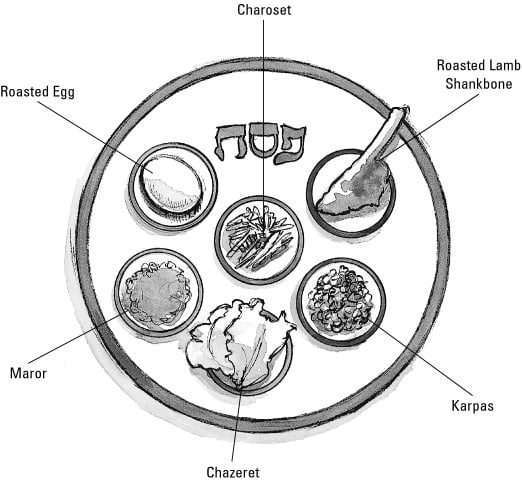
The ritual seder plate.
-
Roasted lamb shankbone: One of the almost hitting symbols of Passover is the roasted lamb shankbone (called zeroah), which commemorates the paschal (lamb) sacrifice made the night the ancient Hebrews fled Egypt. Some people say information technology symbolizes the outstretched arm of God (the Hebrew word zeroah tin mean "arm").
If y'all don't like the thought of a os sitting on your table, y'all may consider using a roasted beet instead. (That's what vegetarians usually practice.) This isn't a new thought; the great Biblical and Talmudic commentator Rashi suggested information technology dorsum in the eleventh century.
-
Roasted egg: The roasted egg (baytsah) is a symbol in many different cultures, usually signifying springtime and renewal. Here it stands in place of one of the sacrificial offerings which was performed in the days of the 2nd Temple. Some other popular interpretation is that the egg is similar the Jewish people: the hotter you lot make information technology for them, the tougher they get. This egg isn't fifty-fifty eaten during the meal; the shell simply needs to look really roasted.
-
Maror ("biting herb"): Any bitter herb will work, though horseradish is the most mutual. Bitter herbs bring tears to the eyes and call up the bitterness of slavery. The seder refers to the slavery in Egypt, but people are called to await at their own bitter enslavements, whether addiction or habit.
-
Charoset: There's nothing further from maror than charoset ("kha-ROH-set"), that sweet salad of apples, basics, vino, and cinnamon that represents the mortar used by the Hebrew slaves to make bricks.
-
Karpas: Karpas is a green vegetable, usually parsley (though any spring dark-green will do). While karpas may symbolize the freshness of spring, others say people eat information technology to make them experience similar dignity or aristocracy. Some families nevertheless use boiled potatoes for karpas, continuing a tradition from Eastern Europe where it was difficult to obtain fresh green vegetables.
-
Chazeret: The chazeret ("khah-ZER-et") is a second bitter herb, most often romaine lettuce, simply people also use the leafy greens of a horseradish or carrot constitute. The symbolism is the same every bit that of maror.
-
Salt h2o: Table salt water symbolizes the tears and sweat of enslavement, though paradoxically, information technology's also a symbol for purity, springtime, and the sea, the female parent of all life. Often a single bowl of salt h2o sits on the tabular array into which each person dips their karpas during the seder. So, information technology's traditional to begin the actual seder meal with each person eating a hardboiled egg (not the roasted egg!) dipped in the bowl of table salt water.
-
Matzah: Perhaps the most important symbol on the seder table is a plate that has a stack of three pieces of matzah (unleavened bread) on it. The matzot (that's plural for matzah) are typically covered with a cloth. People have come up with numerous interpretations for the iii matzot. Some say they represent the Kohen class (the Jewish priests in ancient times), the Levis (who supported the priests), and the Israelites (the balance of the Jews). What symbolism you aspect to this trinity isn't all that important, as long as you're thinking about it.
During the struggles of Soviet Jewry, a fourth piece of matzah was added to the seder plate to symbolize the struggles of Jews who were not even so free enough to celebrate the Passover. Today, some families however use that fourth matzah equally a way of remembering all people who are not yet free to celebrate as they wish.
-
Wine cups and vino (or grape juice): Everyone at the seder has a (usually very small) cup or glass from which they drinkable four cups of wine. Traditionally, the four cups represent the 4 biblical promises of redemption: "I will bring yous out from under the burdens of the Egyptians, and I will rid you lot from their slavery, and I will redeem you with an outstretched arm, and with cracking judgments. And I will take y'all to me for a people . . ." Others say the four cups represent the four messages in the unspeakable Name of God.
Some of the symbols aren't eaten, such every bit the roasted lamb shankbone and the roasted egg. However, when it comes time to consume the karpas, the charoset, and the other symbols, unlike families have different traditions. Some eat the symbols from the seder plate; others give each person their own mini-seder plate to eat from; at larger events, these items may be served family way, with large bowls being passed around so that people tin serve themselves.
Near This Commodity
This article can be institute in the category:
- Jewish Holidays ,
Source: https://www.dummies.com/article/home-auto-hobbies/food-drink/holiday-meals-entertaining/jewish-holidays/the-symbolic-foods-at-a-passover-seder-193276/
0 Response to "How To Roast Eggs For Passover"
Post a Comment