

Parallel Lines And Transversals Project
You've probably seen a set of railroad train lines, a staircase, or a set of piano keys. Is there something that whatever of these accept in common? The two tracks never cross, and the ladder'south two sides never meet. The piano keys are parallel to each other at all times. Let's have a closer look at parallel and transversal lines, as well every bit the angles that they represent to.
Parallel lines: The combination of two or more lines that are stretched to infinity and never intersect each other are called the parallel line or coplanar lines. The parallel lines are denoted by a special symbol, given by ||.
Transversal: A transversal of whatsoever given line is a line that intersects two or more given lines at singled-out points.
Corresponding angles: The angles made when a transversal intersect with whatever pair of parallel lines are chosen the corresponding angles.
The figure below shows both parallel and transversal lines along with the corresponding angles formed by them as:
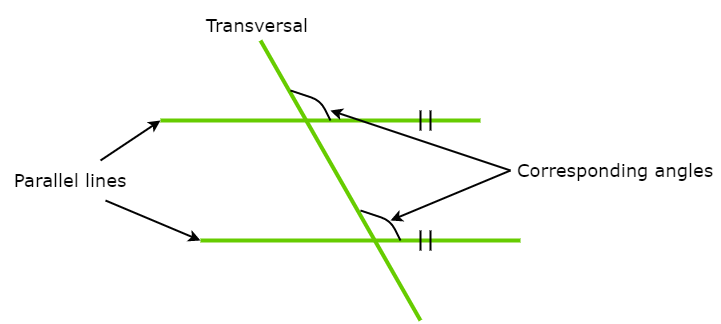
Parallel lines and a transversal
Consider a line l that intersects lines g and north at points P and Q respectively. Therefore, line l is a transversal for lines m and due north where eight different angles are obtained. The eight angles together form four pairs of corresponding angles. As observed in the figure beneath, ∠2 and ∠6 constitute a pair of corresponding angles. All angles that accept the same position with respect to the lines and the transversal are the pair of corresponding angles .
Moreover, the angles that are in the expanse between the lines e.yard. ∠4 and ∠5 are called interior angles whereas the angles that are on the outer side of the two lines e.thousand. ∠1 and ∠8 are called exterior angles . The angles that are on the contrary sides of the transversal are called alternate angles e.g. ∠four and ∠6. The angles which share the same vertex and have a common ray, due east.g. angles ∠i and ∠ii or ∠6 and ∠5 in the figure are called side by side angles . In this case where the side by side angles are formed past two lines intersecting 2 pairs of side by side angles that are supplementary are obtained. The ii angles that are opposite to each other as ∠ane and ∠3 in the figure are chosen vertical angles .
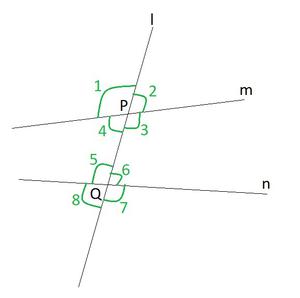
Angles fabricated by Parallel lines and a transversal
Hence, the pair of respective angles, alternate interior angles, alternate outside angles, Interior angles on the aforementioned side of the transversal are every bit follows:
- Corresponding angles: ∠ i and ∠ 5, ∠ 2 and ∠ 6, ∠ iv and ∠ 8 and ∠ three and ∠ 7.
- Alternate interior angles: ∠ 4 and ∠ 6, and ∠ three and ∠ 5.
- Alternate exterior angles: ∠ 1 and ∠ vii, and ∠ ii and ∠ 8.
- Interior angles on the aforementioned side of the transversal: ∠ 4 and ∠ 5, and ∠ 3 and ∠ 6.
Corresponding Angles Axiom
Allow us find out the relation between the angles in these pairs when line chiliad is parallel to line n.
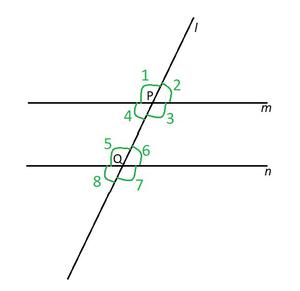
Pair of Corresponding Angles.
Therefore, the Corresponding Angles Axiom is stated as:
If a transversal intersects two parallel lines, such that a pair of corresponding angles is equal, so the two lines are parallel to each other.
To Testify: Respective angles are equal.
Proof: Line m and due north are parallel to each other and line l is traversal.
Since line m and due north are parallel.
Therefore,
∠ iii + ∠ 6 = 180° (Adjacent angle of parallelogram) ……(1)
∠ 7 + ∠ 6 = 180° (Supplementary angles) ……(2)
∠ 3 + ∠ 2 = 180° (Supplementary angle) ……(3)
So, from equation (i) and (2) it is ended that:
∠ three = ∠ 7
Similarly, from (1) and (three) it is concluded that:
∠ 6 = ∠ 2
In this way, it is besides tin be proved that:
∠ 1 = ∠ v
∠ iv = ∠ 8
This implies, that all the 4 pairs of corresponding angles are equal to each other.
Converse of Corresponding Angles Axiom
The converse of corresponding angles axiom is stated as:
If a transversal intersects two lines such that a pair of respective angles is equal, then the ii lines are parallel to each other.
Pair of Corresponding Angles.
To Prove: If corresponding angles are equal, then lines are parallel.
Proof: Line l is traversal to lines m and north.
Therefore,
∠ iii = ∠ seven (Given, respective angles are equal) ……(1)
∠ seven + ∠ 6 = 180° (Supplementary angle) ……(ii)
And so, from equation (1) and (2) information technology is concluded that:
∠ 3 + ∠ 6 = 180°
As, sum of adjacent angles is supplementary.
Hence, lines are parallel.
Alternate Angles Axiom
The alternating angles axiom is stated as:
If a transversal intersects two parallel lines, so each pair of alternate interior angles is equal.
Pair of alternate angles.
To Prove: Alternate interior angles are equal.
Proof: Line m and north are parallel to each other and line l is traversal.
∠ 3 = ∠ 7 (Respective angles axiom) ……(one)
∠ seven = ∠ v (Vertically opposite angles) ……(2)
And so, from equation (one) and (2) it is concluded that:
∠ 3 = ∠ v
Similarly, it tin be written as:
∠ 4 = ∠ 6
Hence, alternating interior angles are equal.
Antipodal of Alternate Angles Axiom
The antipodal of alternate angles axiom is stated as:
If a transversal intersects two lines such that a pair of alternate interior angles is equal, then the two lines are parallel.
Pair of alternate angles.
To Evidence: If alternate interior angles are equal, then 2 lines are parallel.
Proof: Line m and n are parallel to each other and line 50 is traversal.
Therefore,
∠ 3 = ∠ 5 (Alternating interior angles) …….(1)
∠ 7 = ∠ 5 (Vertically opposite angles) …….(2)
And then, from equation (ane) and (2) it is concluded that:
∠ 3 = ∠ 7
According to the converse of corresponding angles axiom: If a transversal intersects two lines such that a pair of corresponding angles is equal, so the two lines are parallel to each other.
Hence, the ii lines are parallel.
Property of interior angles on the same side of the transversal
The belongings of interior angles is stated every bit:
If a transversal intersects two parallel lines, then each pair of interior angles on the same side of the transversal is supplementary.
Pair of interior angles
To Bear witness: If a transversal intersects ii parallel lines, so each pair of interior angles on the aforementioned side of the transversal is supplementary.
Proof: Line m and n are parallel to each other and line l is traversal.
Therefore,
∠ 3 = ∠ vii (Respective angles axiom) ……(i)
∠ vi + ∠ 7 = 180° (Supplementary angle) ……(two)
And so, from equation (i) and (2) information technology is ended that:
∠ 6 + ∠ iii = 180°
Hence, each pair of interior angles on the aforementioned side of the transversal is supplementary.
Antipodal of the property of interior angles on the same side of the transversal
The converse of the holding of interior angles is stated as:
If a transversal intersects two lines such that a pair of interior angles on the aforementioned side of the transversal is supplementary, and then the ii lines are parallel.
Pair of interior angles.
To Prove: If a transversal intersects two lines such that a pair of interior angles on the aforementioned side of the transversal is supplementary, then the two lines are parallel.
Proof: A Pair of interior angles on the same side of the transversal is supplementary.
∠ 6 + ∠ three = 180° (Given, sum of pair of interior angles is supplementary) ……(1)
∠ six + ∠ seven = 180° (Supplementary bending) ……(2)
Then, from equation (1) and (two) it is concluded that:
∠ vii = ∠ 3
Hence, 2 lines are parallel.
Lines Parallel to the Aforementioned Line
The theorem of lines parallels to the same line is stated equally:
Lines which are parallel to the same line are parallel to each other.
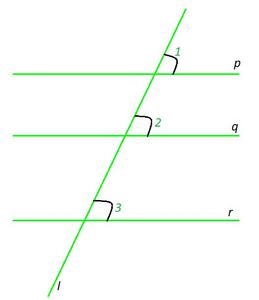
Lines Parallel to the Same Line.
To Show: Lines which are parallel to the same line are parallel to each other (p || q || r).
Proof: Line p and r are parallel and lines p and q are parallel to each other and line 50 is traversal.
At present, p || q and p || r
Since m || q therefore,
∠ 1 = ∠ 2 (Corresponding angles axiom) ……(1)
∠ one = ∠ three (Corresponding angles axiom) ……(two)
So, from equation (1) and (2) it is concluded that:
∠ 2 = ∠ iii
All the same, co-ordinate to the converse of corresponding angles axiom, If a transversal intersects two lines such that a pair of corresponding angles are equal, then the 2 lines are parallel to each other.
Hence, the two lines q and r are parallel and so parallel to r.
Sample Issues
Trouble 1: In Figure, if PQ || RS, ∠ MXQ = 135° and ∠ MYR = xl°, observe ∠ XMY.
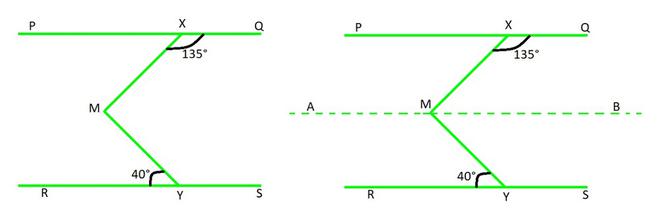
Solution:
Lets construct a line AB parallel to line PQ, through point M.
Now, AB || PQ and PQ || RS
⇒ AB || RS || PQ (Theorem 5)
∠ QXM + ∠ XMB = 180° (AB || PQ, Interior angles on the same side of the transversal XM)
As, ∠ QXM = 135°
135° + ∠ XMB = 180°
∠ XMB = 45°
Now, ∠ BMY = ∠ MYR (AB || RS, Alternate angles)
∠ BMY = 40°
As, ∠ XMB + ∠ BMY = 45° + 40°
Therefore, ∠ XMY = 85°.
Problem 2: If a transversal intersects ii lines such that the bisectors of a pair of corresponding angles are parallel, then prove that the ii lines are parallel.
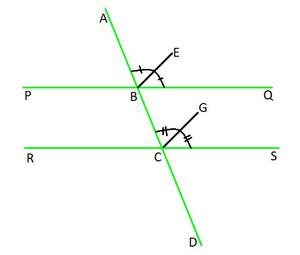
Solution:
Let a transversal AD intersects two lines PQ and RS at points B and C respectively. Ray BE is the bisector of ∠ ABQ and ray CG is the bisector of ∠ BCS and BE || CG.
To prove: PQ || RS.
Given that, the ray BE is the bisector of ∠ ABQ.
Therefore, ∠ ABE = ½ ∠ ABQ ……(1)
Similarly, ray CG is the bisector of ∠ BCS.
Therefore, ∠ BCG = ½ ∠ BCS ……(2)
Using Corresponding angles axiom,
∠ ABE = ∠ BCG (BE || CG and Advertising is the transversal) ……(3)
Using (1) and (2) in (3), you get
½ ∠ ABQ = ½ ∠ BCS
That is, ∠ ABQ = ∠ BCS
Every bit they are the corresponding angles formed past transversal Advertising with PQ and RS.
Therefore, PQ || RS. (Converse of corresponding angles axiom)
Problem 3: In Figure, AB || CD and CD || EF. Besides EA ⊥ AB. If ∠ BEF = 55°, find the values of ten, y and z.
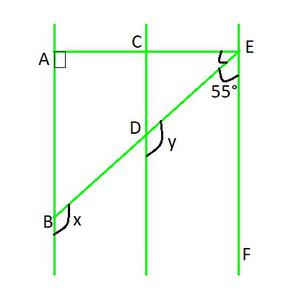
Solution:
Since, AB || CD and CD || EF
⇒ AB || CD || EF (Lines which are parallel to the same line are parallel to each other)
And, EB and AE are transversal.
y + 55° = 180° (CD || EF, Interior angles on the same side of the transversal EB)
y = 180º – 55º = 125º
As, ten = y (AB || CD, Respective angles axiom)
x = y = 125º
Now, ∠ EAB + ∠ FEA = 180° (Interior angles on the same side of the transversal EA)
ninety° + z + 55° = 180°
Hence, z = 35°.
Problem iv: In Figure, find the values of x and y and then show that AB || CD.
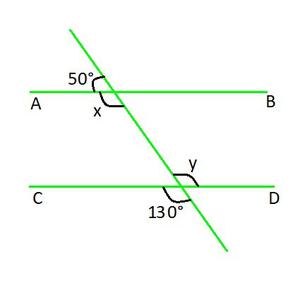
Solution:
Here,
x+l° = 180° (linear pair is equal to 180°)
ten = 130°
and, y = 130° (vertically reverse angles are equal)
Here, what we can notice is,
x = y = 130°
In two parallel lines, the alternate interior angles are equal.
Hence, this proves that alternate interior angles are equal and so, AB || CD.
Problem five: In Figure, if AB || CD, ∠ APQ = 50° and ∠ PRD = 127°, find x and y.
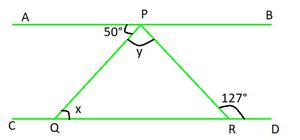
Solution:
Here, APQ = PQR (Alternate interior angles)
x = 50°
And,
Apr = PRD (Alternate interior angles)
APQ+QPR = 127°
127° = 50°+ y
y = 77°
Hence, the values are, ten = 50° and y = 77°.

Parallel Lines And Transversals Project,
Source: https://www.geeksforgeeks.org/parallel-lines-and-transversals/
Posted by: brambletiont1992.blogspot.com
0 Response to "Parallel Lines And Transversals Project"
Post a Comment